Endings are not punishments. They are passages. When you face change, do not resist, but open your wings. Death clears the way for renewal.
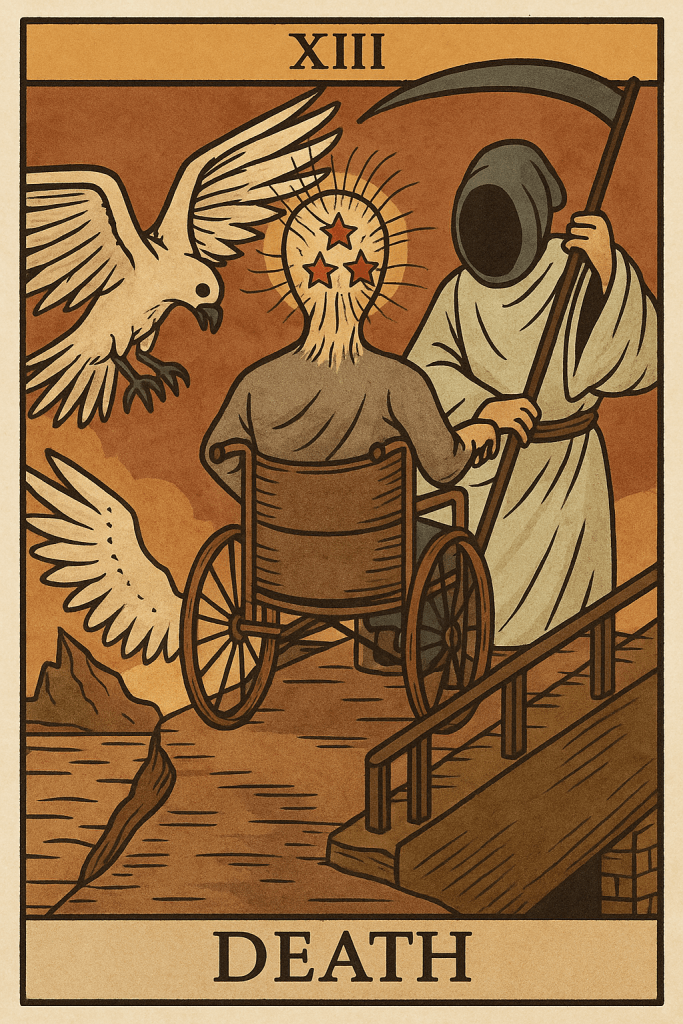
The Death card arrives not as a terror, but as a truth: a reminder that endings are woven into the very pattern of existence. In this depiction, the cloaked Reaper gently accompanies a figure in a wheelchair along the final path. Bonnie, the sulphur-crested cockatoo, flies beside them bearing witness.
Bonnie does not fear what lies ahead for the dying one. She knows that death is not annihilation but transformation, a passing from one state of being into another. Her thoughts are simple and clear: all wings molt, all feathers fall, but still the bird takes flight again. She does not cry out in alarm—she offers presence, a gentler rhythm alongside the steady tread of inevitability.
The extra wing that arcs across the scene is a symbol of transition. It does not belong to Bonnie, nor to the Reaper, but to the unseen—the soul in flight. Where one set of wings is bound to the body, the other belongs to the spirit, showing that death grants a liberation beyond what the flesh could hold. This second wing is not a duplicate, but an opening, a sign that no passage is made alone.
Here, acceptance is key. The figure does not resist; the Reaper does not threaten. This is not a card of violence, but of yielding, of allowing what must come. In its deepest meaning, the card teaches that endings—be they of life, relationships, or old ways of being—are necessary for new beginnings to be born.
 The Tarot Midwife