Writing Portraiture

“The portrait is generally a form of description, and like all descriptions it is a particularly enjoyable device to reread. Anais Nin is the master of descriptive portrait in the diary. Nin made an effort to be fair and free of malice in her word-portraits of friends and acquaintances, though she was aware of weaknesses as well as talents of those she described. In writing portraits she tried to include as many details as possible about herself and the other person”.
Tristine Rainer The New Diary.
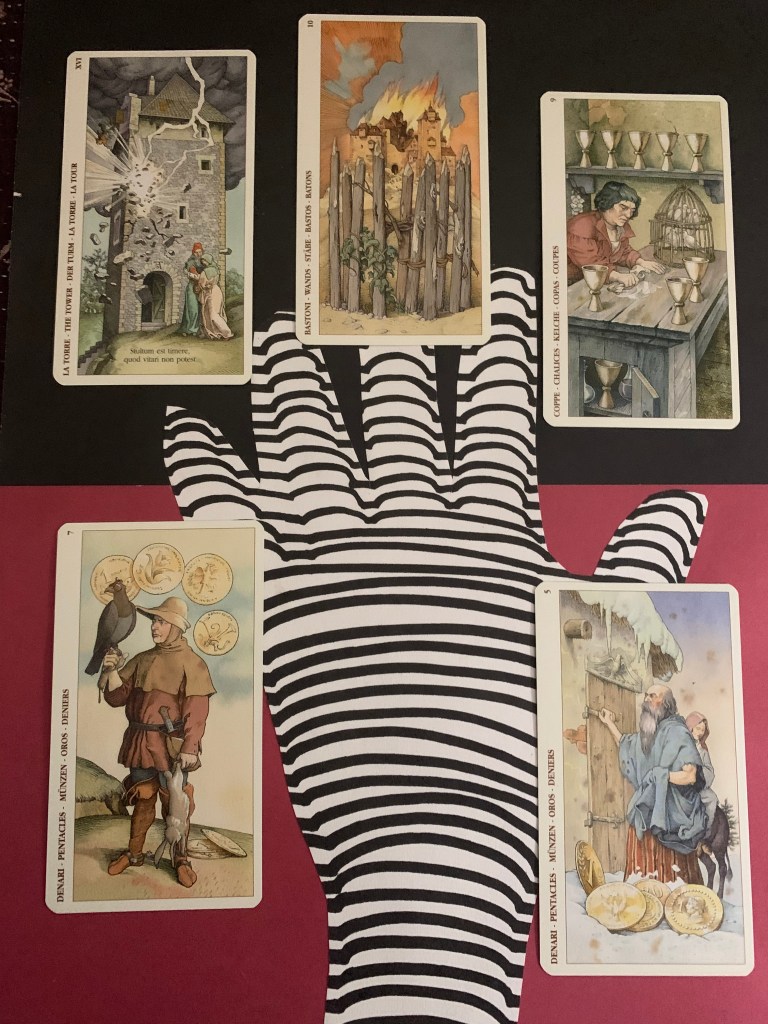
‘The Hand’ is a device I have repeatedly used in writing classes. I have people place their hand on their notebook and draw around their fingers. Then I suggest that they lay down some cards. The card for the thumb is the primary figure for this word-portrait. The other four fingers represent people and events that have impacted on this persons life.

  • Carefully look at the pictures. Make sure to take in as much detail as possible. It is important to look very closely. 
  • What are the different elements? Plants? Buildings? Flowers? Animals? What is the landscape? Are there people in the card? What is the person in the picture doing? What objects do you see? Why do you think they are there? What’s in the background? What’s in the foreground? How do all of these different elements come together into a coherent story?
  • Notice every small and large detail and make a note of it. Absorb the entire card into your mind.
  • Now set your timer for 20 minutes. And start writing remembering that you are not in a writing competition.

“Remember that a portrait done like this is never really finished. You can always recolour it, revise it, contradict it, add to it. The mobile,  evolving quality of the portrait makes it a useful tool in recognizing the psychological process of projection. Rather than just seeing the person on his or her terms you are likely to see a mirror reflection of yourself and gain insights about yourself. By writing portraits you begin to see if the face you are describing is your own”. Tristine Rainer The New Diary

Telling Tarot Stories

Great Tarot readers, like writers, know how to weave the story between the Tarot cards to create highly engaging and meaningful Tarot readings for their clients. They see patterns between the cards and combine these intuitive messages into a beautiful story that is unique to the client and their situation. This exercise is good for writers looking to warm their hand by practicing on a daily basis. It is also a good practice for a tarot reader to strengthen their spontaneous story telling skills

Every Tarot card contains its own unique story and each story can be expanded by using more than one card. Every card in a Tarot deck is connected by an invisible thread.

As writers looking to maintain a daily practice Tarot cards are a wonderful source of inspiration.

Over a cup of tea or coffee one way to start the day is to quietly shuffle a pictorial deck and draw some cards. In this instance I chose the Tarot of the Durer which is an art deck compiled by taking scenes from some of Durer’s famous work. I opted to choose just two cards.

Lay out your cards as I have done here.

  • Carefully look at the pictures. Make sure to take in as much detail as possible. It is important to look very closely. For example, did you notice that the eagle is chained and that there is an ominous raven shaped cloud above the old man in the 10 of Pentacles? What is your impression of Temperance’s mood? How is she relating to the cow? What is her connection to the elderly man in the 10 of Pentacles?
  • What are the different elements? Plants? Buildings? Flowers? Animals? What is the landscape? Are there people in the card? What is the person in the picture doing? What objects do you see? Why do you think they are there? What’s in the background? What’s in the foreground? How do all of these different elements come together into a coherent story?
  • Notice every small and large detail and make a note of it. Absorb the entire card into your mind.
  • Now set your timer for 20 minutes. And start writing and sketching, remembering that you are not in a writing or art competition.
  • Make up a story as you go along. Use the elements from the picture in your story. You can be as creative as you like – just let yourself go wild. Write down a story in the 20 minutes you’ve set aside.

Warming the Hand – Honing One’s Knowledge of Pentacles

I keep to this routine every day without variation. The repetition itself becomes the important thing; it’s a form of mesmerism. I mesmerize myself to reach a deeper state of mind.
Haruki Murakami

Write freely and as rapidly as possible and throw the whole thing on paper. Never correct or rewrite until the whole thing is down. Rewrite in process is usually found to be an excuse for not going on. It also interferes with flow and rhythm which can only come from a kind of unconscious association with the material.
Steinbeck

When I run writing classes I always promote the benefit of writing on a daily basis to keep the ‘hand warm’ so to speak.

In this instance I have chosen a character, the Hermit, from the Major Arcana and placed him alongside the court cards of the suit of Pentacles. Then I laid out the 10 cards to represent his journey back into the outside world.

To begin I have decided that the Hermit has been living in isolation in Cappadocia for many years. Word has reached him about the dramatic changes that have taken in the outside world and he has decided to venture out again.

I will make notes about his journey as he moves through this suit.

Of course, working in this way is also a good way to sharpen your knowledge of the cards in a new deck and refine your readings.

Everything Has A Story

Like Sleeping Beauty I am waking up – woken by the voices of all the things I have never thought to stop and listen to, that are eager for me to tell their story. As I listen I have some Tarot Cards with me because they help ‘translate’ the message from an item like a traffic sign or the windmill that has stood out in the weather for decades
The Tarot Midwife November 9 2020

My loyal companion, Archie, a Finnish Lappie, and I headed out to the Muckleford Railway Station armed with a copy of the Little Red Engine. We had been there the day before and decided that we would go back and read this story to the carriages that are lined up on the side tracks.

We found a place to sit and began reading this delightful old children’s book, that once belonged to my children, to the old railway carriages. We didn’t get right through the story because we were both suddenly aware that these so called inanimate carriages and Aunty Jack, the old engine that pulled them on long hauls, were getting quite emotional.

To check what had upset everyone I pulled a card from the Tarot of the Sweet Twilight and out popped the Three of Swords.

It all became very obvious. These loyal, hardworking, heavy duty carriages were devastated to have found themselves abandoned on side tracks here, while Betsy, a light weight steam train blew its whistle and gloated as it skipped past, filled with passengers, city slickers, enjoying a journey down memory lane.

When things calmed they said that they did appreciate hearing the story and that if I would come back they would tell me of some of the places they passed when they were carrying goods and animals back in the day when the railway was the main means of transport.

Aunty Jack the old engine who pulled huge loads through Central Victoria.

Aunty Jack, the Empress, the powerful engine who pulled these carriages for years, brightened at the prospect of having someone listen. I told her about my Great Grandfather who worked as an engineer and oversaw the laying of rails in the 1860’s and she was delighted to hear about his foresight and passion for rails. She suggested that when I come back I tell her more about his days building the railway that bought such change to colony.

Footnote: A delightful mechanic/engineer, who I sat enjoying a cup of coffee with at Dig in nearby Newstead, told me that railway men always give engines female names. He said that in his younger days the really strong ones, with a ton of personality, were invariably known as Aunty Jack. It was he who shared that some were known as Betsy and Val. I decided that the old Steam Train that travels between Castlemaine and Maldon, through the Muckleford Station, is known here as Betsy.

Meet Anastasia Riversleigh

Anastasia Riversleigh is just one of my alter egos. She is a member of the Skull Clan who is currently working, primarily, with the Tarot of the Vampyres. Given that she is taking this opportunity to do important shadow work she will be leaning on numerous decks and other resources.

Visit her and you will find a detailed journal which records her newest adventure, in residence, living and playing with many interesting internal characters at Shadwell Manor and on the old Ghostly Spanish Galleon that sails the seven seas.

Tarot Based Memoir

Choose a pictorial deck and lay out a complete minor arcana. You might, for example lay out a suit that is alignment with your zodiac sign. For example, I am a Virgo and I might choose to use the earth based pentacles.

Use the cards to tell write a narrative about your life. Think of the first 3 cards being the beginning of the story, the second set of three cards being the middle of the story and the last three cards being the end.


Fiction Inspired by Tarot

For something so universally recognizable, most people know little about the tarot outside of its supposed ability, with the help of a skilled reader, to foretell the future. Tarot cards are very rich in symbolism and occult significance. With their mysterious illustrations and buried meanings so open to interpretation, it’s hardly surprising that a number of sci-fi and fantasy books have incorporated the Tarot into their world building. If anything, it’s surprising there aren’t more of them: staring into the Tarot is like staring into a ominous mirror-world.
Source: Barnes and Noble

A review of the Creative Tarot by Two Sides Tarot.

A cursory glance online reveals that figures in the literary world are recognising, what many of us know. Tarot can make a significant contribution to the craft of writing.

“The Creative Tarot: A Modern Guide to an Inspired Life” by Jesse Crispin is a manual intended to show that the tarot deck, primarily regarded as belonging to the domain of the esoteric, can be useful for anyone engaged in creative pursuits.

Like Crispin, at the risk of being deemed a “weirdo mystic”, I am prepared to publicly come out of the spiritual closet and promote the benefits of turning to a deck of cards for inspiration for fiction and art. Aside from the fact that I have seen the benefit of using cards in writing classes, I am in esteemed company. Many respected writers have made use of the tarot: Yeats, Italo Calvino, Salvador Dali, and even Charles Williams, a novelist and theologian who belonged to the Inklings literary circle, have drawn on the cards for inspiration.

Given that many Tarot cards actually depicted imagery of Medieval Dramas that took place in Italy it is not surprising that the cards, which feature characters from those plays, offer a springboard for aspiring wordsmiths.  In a post entitled Tarot Fairy Stories I presented a case for using the Cosmic Tarot to help generate a fairy story set in a fantasy world. Needless to say there is a lot more that can be done.

When I found Tribu Arcane, a set of playing cards, in a second hand book shop I couldn’t help adding it to my collection. This deck features a different, traditional image on each card. 

In a writing session I laid out the suit of hearts and we spent time considering what story is being revealed. We discussed what ideas might be researched and to kick start discussion I suggested that we could write something about a vibrant dancing troupe who travel, presenting spontaneous performances under sprawling Marula Trees. It is always inspiring to hear other ideas that come forward from the group.

Pull out a deck and experiment! Feel free to share any ideas in the comment section!