Setting Out: Yule AdvenTURE

Alice was beginning to get very tired of sitting by her sister on the bank, and of having nothing to do: once or twice she had peeped into the book her sister was reading, but it had no pictures or conversations in it, `and what is the use of a book,’ thought Alice `without pictures or conversation?’

So she was considering in her own mind (as well as she could, for the hot day made her feel very sleepy and stupid), whether the pleasure of making a daisy-chain would be worth the trouble of getting up and picking the daisies, when suddenly a White Rabbit with pink eyes ran close by her.

There was nothing so very remarkable in that; nor did Alice think it so very much out of the way to hear the Rabbit say to itself, `Oh dear! Oh dear! I shall be late!’ (when she thought it over afterwards, it occurred to her that she ought to have wondered at this, but at the time it all seemed quite natural); but when the Rabbit actually took a watch out of its waistcoatpocket, and looked at it, and then hurried on, Alice started to her feet, for it flashed across her mind that she had never before seen a rabbit with either a waistcoat-pocket, or a watch to take out of it, and burning with curiosity, she ran across the field after it, and fortunately was just in time to see it pop down a large rabbit-hole under the hedge.

In another moment down went Alice after it, never once considering how in the world she was to get out again. Chapter 1 Alice in Wonderland

The door may appear locked but if you say the right words it will magically open and you can join a Yule Adventure.

It is recommended that, unlike Alice, you spend a little time thinking about what you are going to need. Think about what you would pack in a creative medicine bag to carry, to protect you as you wander in strange new worlds.
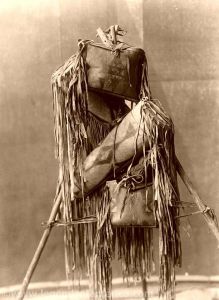
A Native American medicine bag or medicine bundle, upon which this idea is based, is a container for items believed to protect or give spiritual powers to its owner. Varying in size, it could be small enough to wear around the neck, or it could be a large bag with a long strap called a “bandolier.” The size of the bag is determined by how many items need to be carried.

In historical times, medicine men and shamans generally carried a large medicine bundle that could hold numerous items such as seeds, herbs, pine cones, grass, animal teeth or claws, horsehair, rocks, tobacco, beads, arrowheads, bones, or anything else of relatively small size that possessed spiritual value to the bundle’s owner. Warriors also carried bundles that included important items, such as rattles, animal furs, special stones, or anything that meant something to the owner.

Packing to Go.

Check out some comments by people who Packed to Go back in 2005.
Share an image of the bag you pack to come on this Yule Adventure.
What will you pack? Tell us what you are putting in it and how you feel about heading out during this festive season.

Some Creative Medicine Bags

Pandemic Free Writing Zone

When Victoria went into its fifth lockdown last week, classes that I had offered in a couple of Library settings were cancelled. This is disappointing for everyone and adds to the cocktail of negative noise that we have all been dealing with. 

As Nitchke explains “the human brain has the capacity to imagine all the worst things that could happen. And the more uncertainty there is — especially if that uncertainty is coupled with gloomy hypotheticals — the more likely the brain is to conjure up and fixate on the worst-case scenarios.

I wish it were otherwise but we are going to be faced with uncertainty for quite some time! So I decided that one way of providing a tiny bit of certainty is to offer regular writing/art sessions in a Zoom setting. 

Participants will have a regular meeting time and projects (lockdown friendly if the need arises) to occupy themselves before meeting again.

The cost is $15 per a one and a half hour session.

If you are interested in joining a group of a maximum of 5 participants, for a block of 6 weeks, on a Tuesday evening at 8 pm AET simply email heatherblakey at fastmail dot fm. Other times can be made available depending on interest.

Writing for Wellness

Pens, crayons, pencils and IV tubes may not seem to have much in common but the arts are increasingly touted as a form of healing that can be as relevant to a patients wellbeing as medication. A developing body of research shows that expressive writing helps calm the mind and emotions, and increases feelings of happiness and wellbeing.

In this course we will use guided writing activities as a gentle approach to personal wellbeing. You will be offered tools which you can take away and use in your daily writing and art practice.

The enjoyable and easy-to-do activities will help you:

  • reunite with your most creative self
  • dip into Mnemosynes Well of Memory using simple lists as stepping stones
  • apply guided imageries and visual imagery as a kick starter to daily writing
  • alter your perspective by communicating with fragments of nature
  • experience the catharsis that comes with writing letters to past and future selves
  • create detailed portraitures
  • explore a range of emotions

About Heather Blakey

Heather Blakey has had over thirty years experience as a secondary school teacher in Melbourne’s Northern suburbs and she has recently graduated as a Master of Social Work at Monash University.

Between 2000 and 2010 she built and managed the critically acclaimed Soul Food Cafe a site which was acknowledged by Writers Digest and authors such as Sark and Jean Houston. While she no longer runs this labyrinthine website Soul Food informs how she works and has influenced writing courses that she runs regularly.

​Heather describes herself as a purveyor of stimuli and an artistic midwife. She has worked as a specialist teacher of writing with people of all ages and believes that the expressive arts, and writing in particular, not only promotes wellness in those who trust the process and engage but helps people identify and value their unique voice.

The Spirit of the Fungi

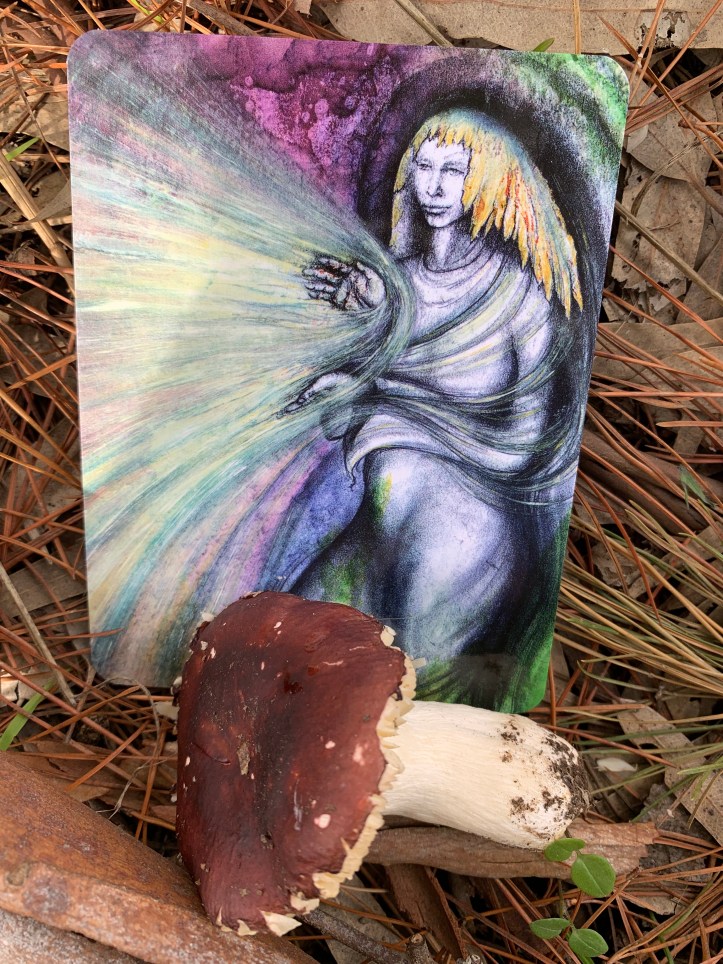
I pause to commune with the serene spirit of the Fungi. She may live in darkened places but her light shines brightly and she is full of wisdom. 

“For millennia, western thinking has been dominated by the idea that we are separate from, and superior to, the rest of nature. Plants and fungi are seen as dumb, mechanical processes that we can plunder for materials and chemicals without considering how we relate to them. Other cultures see other lifeforms as peers. They are viewed as creatures deserving of respect and from whom we might be able to learn something. 

From our human-centered perspective, fungi seem rather inert and unimpressive. They don’t move much and seem to be uninteresting passive objects rather than intelligent beings. Just because they don’t move, however, doesn’t mean they don’t have behavior”. 

Life as we know it would not exist without fungi. They are the critical link in the biological cycle of life and death. 

Fungi are the great recyclers. They play a major part, with prokaryotes such as bacteria, in breaking down organic matter. Without them we would soon be up to our ears in dead plant matter and animal carcasses. Worse still, we would be surrounded by mountains of dung that would not rot. 

Plants would soon run out of fresh nutrients. Animals in turn would go hungry. 

There would be no forests. Few people realize that trees rely on networks of fungi working in partnership with their roots. Without fungi to make nutrients available, trees would be unable to survive. Consider the many roles trees play in supporting life on earth and you’ll realize the importance of this union. 

Reference: The Fungus Amongst Us

A Fools Journey

Once upon a time, long before there was once upon a time, an old crone decided that she needed to make one final creative journey and add another star to the constellation in the skies that shone within her private universe. She was not in the least surprised when a Raven and a Donkey insisted on coming along, for they had travelled with her before.

This image has an empty alt attribute; its file name is img_3949.jpeg

What did startle her was the arrival of a flamboyant, charismatic Sulphur Crested Cockatoo named Bonnie. She suspected that Bonnie was one of the flocks that had raided her beloved Ornamental Pistachio Tree each year because she was quite sure that she had seen and photographed a bird, with attitude, who looked just like her.

Duncan the Donkey made it clear that he was getting too old to carry heavy loads and while the Crone agreed that it would be good to travel lightly she did ask Duncan to carry some of her art supplies and made sure to tuck a few of her Tarot and Oracle cards into her bag. She had relied on them during the long ‘lockdowns’ and wasn’t about to go anywhere without her most trusted ones.

Bonnie’s sharp eye caught a glimpse of these boxed treasures and, because she is such an inquisitive bird, wanted to know more about them. The Crone began to explain the Major Arcana to her and was surprised to discover that Bonnie was more fascinated than any of her human friends had been.

“Perhaps you will teach me about these Majors as we travel” said Bonnie.

“What a good idea” said the Crone. “There is so much that I am yet to learn and we could always learn together”.

A Fools Journey

Brand Bonnie

From the Crone’s Diary

Other material of interest

Interested in Mythic Journey’s? Check out the work of Christopher Vogler and his book The Writers Journey

Getting to Know You

It will come as no surprise to anyone who has followed me on Instagram that I do not profess to be a Tarot reader. I certainly do not claim to be familiar with the meanings of all the cards. My primary interest has been exploring the potential of these mini galleries of art to inspire the creative arts and support healing.

I began the process by listening to Julie Andrews sing Getting to Know You as I shuffled the Everyday Witch cards. It was the Six of Pentacles, a card all about giving and receiving that emerged. So clearly the Witch depicted in this card is prepared to help even the playing field and share some of her knowledge with me; teach me about the world of Tarot.

So when I was told by an experienced Tarot reader that she wished that the Everyday Witch had been available when she was learning 20 years ago, that she strongly recommends this deck to beginners I figured it was time to go beyond the interview process and actually get to know this deck, get to know Tarot better. Of course I have made resolutions like this before but I am not going to beat myself up because I am aware that PTSD issues and the nature of technology have impacted on my capacity to focus.

For now it is my intention to set up some Tiny Tea each day and work with some cards. I am hoping to study the Everyday Witch in detail and draw comparisons with cards in other decks that I have in my collection.

Tarot Play Time – Play Theatre

I think I am not the only one intrigued by the picturesque of early Tarot cards. What do they really represent? Who drew them? Who put all these icons together?

Then I saw Dario Fo, the great Italian comedian of Comedia dell Arte, play writer and Nobel Prize winner, acting on stage playing the hilarious figure of a barbarous Pope (I cannot recall who). and I thought that something of the medieval feasts, mysteries and banquets were radiating from the stage… from Origins of the Tarot Cards from Medieval Mystery Plays

I spied with my little eye the Magnetic Play Theatre that I obviously kept, which belonged to my daughter when she was little.

It only took a moment to find out about the connection between Tarot and Medieval Playhouses and for my inner child to point out that this would be a fun way to play with Tarot and write all at the same time.

So I set up my Rose and Swan Playhouse and called upon the Fiddler on the Roof Matchmaker to make me a match. The Lions Gateway Tarot by Jessica Henry was the obvious choice and I have to say it was love at first sight. These two may have quite the romance as they bounce off one another.

As I laid down the card that emerged from Henry’s beautiful deck I thought of fairy stories and the Canterbury Tales.  Given Tarots power to teach about morality, I might even be happy to  write a scene for a morality play.

Writing Portraiture

“The portrait is generally a form of description, and like all descriptions it is a particularly enjoyable device to reread. Anais Nin is the master of descriptive portrait in the diary. Nin made an effort to be fair and free of malice in her word-portraits of friends and acquaintances, though she was aware of weaknesses as well as talents of those she described. In writing portraits she tried to include as many details as possible about herself and the other person”.
Tristine Rainer The New Diary.

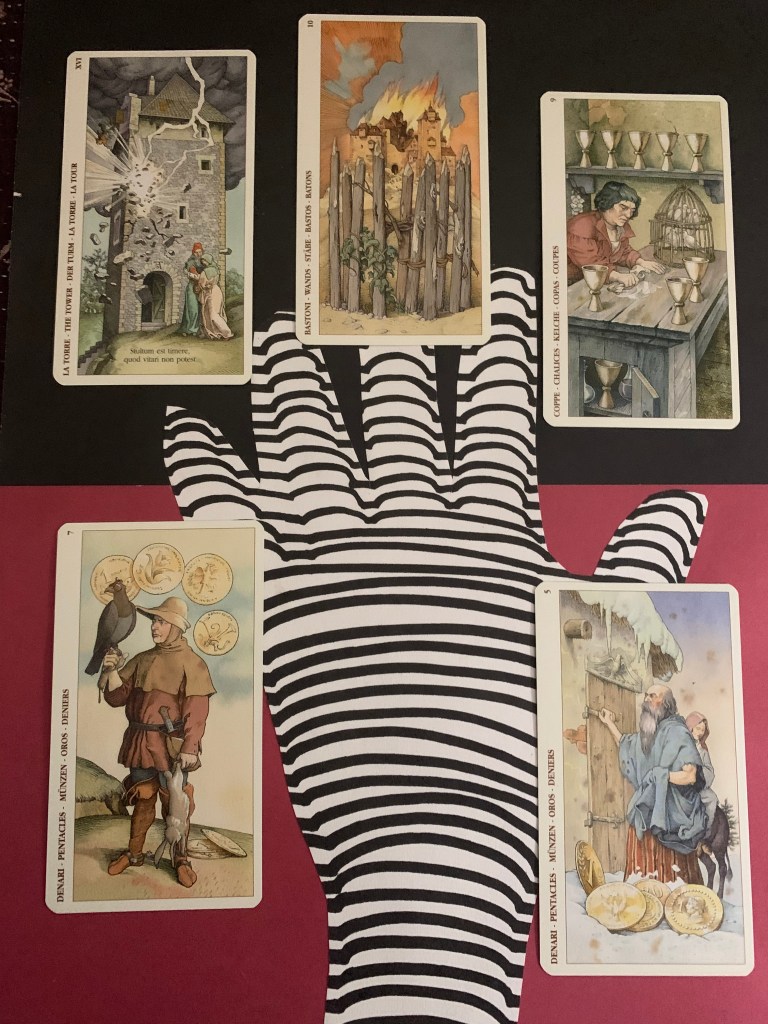
‘The Hand’ is a device I have repeatedly used in writing classes. I have people place their hand on their notebook and draw around their fingers. Then I suggest that they lay down some cards. The card for the thumb is the primary figure for this word-portrait. The other four fingers represent people and events that have impacted on this persons life.

  • Carefully look at the pictures. Make sure to take in as much detail as possible. It is important to look very closely. 
  • What are the different elements? Plants? Buildings? Flowers? Animals? What is the landscape? Are there people in the card? What is the person in the picture doing? What objects do you see? Why do you think they are there? What’s in the background? What’s in the foreground? How do all of these different elements come together into a coherent story?
  • Notice every small and large detail and make a note of it. Absorb the entire card into your mind.
  • Now set your timer for 20 minutes. And start writing remembering that you are not in a writing competition.

“Remember that a portrait done like this is never really finished. You can always recolour it, revise it, contradict it, add to it. The mobile,  evolving quality of the portrait makes it a useful tool in recognizing the psychological process of projection. Rather than just seeing the person on his or her terms you are likely to see a mirror reflection of yourself and gain insights about yourself. By writing portraits you begin to see if the face you are describing is your own”. Tristine Rainer The New Diary

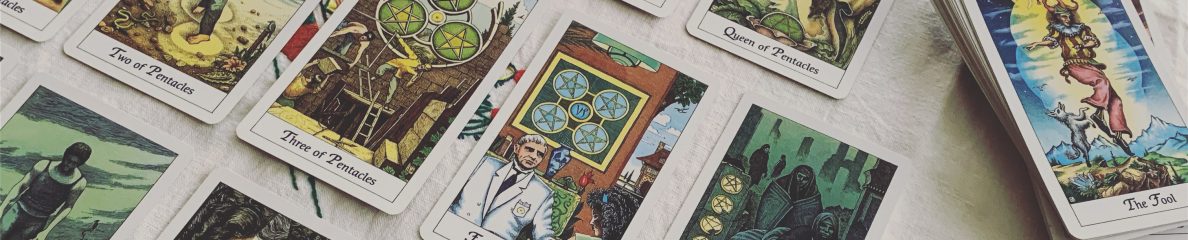
Warming the Hand – Honing One’s Knowledge of Pentacles

I keep to this routine every day without variation. The repetition itself becomes the important thing; it’s a form of mesmerism. I mesmerize myself to reach a deeper state of mind.
Haruki Murakami

Write freely and as rapidly as possible and throw the whole thing on paper. Never correct or rewrite until the whole thing is down. Rewrite in process is usually found to be an excuse for not going on. It also interferes with flow and rhythm which can only come from a kind of unconscious association with the material.
Steinbeck

When I run writing classes I always promote the benefit of writing on a daily basis to keep the ‘hand warm’ so to speak.

In this instance I have chosen a character, the Hermit, from the Major Arcana and placed him alongside the court cards of the suit of Pentacles. Then I laid out the 10 cards to represent his journey back into the outside world.

To begin I have decided that the Hermit has been living in isolation in Cappadocia for many years. Word has reached him about the dramatic changes that have taken in the outside world and he has decided to venture out again.

I will make notes about his journey as he moves through this suit.

Of course, working in this way is also a good way to sharpen your knowledge of the cards in a new deck and refine your readings.

Story Starter Using Raincoast Tarot

Writing has tremendous energy. If you find a reason for it, any reason, it seems that rather than negate the act of writing, it makes you burn deeper and glow clearer on the page. Ask yourself, “Why do I write?” or “Why do I want to write?” but don’t think about it. Take pen and paper and answer it with clear, assertive statements. Every statement doesn’t have to be one hundred percent true and each line can contradict the others. Even lie if you need to, to get going. If you don’t know why you write, answer it as though you do know why.

— Natalie Goldberg, Writing Down the Bones

When I am running writing classes I like to offer speed stream of consciousness writing activities to ‘warm the hand’.

This spread by @radiantunknown is the perfect spread to generate some writing, preferably on scrap paper. I encourage people to begin by sketching, posing some questions and making lists of things that come to mind.

Natalie Goldberg provides this idea which I have seen used by teachers training actors

I suggest that you place your primary character on a page and then make use of the following format to create your own character.

No cheating. Do not simply fill in the blanks by describing yourself or someone you know. Instead, fill in the blanks describing someone you’d find it interesting to know. Then, remembering that conflict is the essence of all dramatic writing, repeat the process by imagining a character whose value, attitudes, etc. would likely put them in opposition to the first character you invented.

Full Name:
Nicknames:
Sex:
Age:
Height:
Weight:
Hair:
Eyes:
Skin:
Posture:
Appearance:
Health:
Birthmark:
Abnormalities:
Heritage:
Where born:
Where live:
Favorite food:
Favorite subject in school:
Favorite game as child:
Best memory:
Worst memory:
Smoke/Drink/Drugs Profile:
Favorite section of newspaper:
Favorite type of music:
Last book read:
Last movie seen:
Morning or night person:
Introvert/Extrovert:
Indoor or outdoor person:
Greatest fear:
Closest friend:
Dearest possession:
Favorite season:
Class:
Occupation:
Education:
Family:
Home Life:
IQ:
Religion:
Community:
Political Affiliation:
Amusements/Hobbies:
Reading Interests:
Sex Life:
Morality:
Ambition:
Frustration:
Temperament:
Attitude:
Psychological Complexes:
Superstitions:
Imagination

Then we set a timer and write for twenty minutes without thinking or worrying about grammar.

As a follow on you can put your character in the centre of this spread and begin building on their story using the cards that emerge.

Joan of Arc Spread

Joan of Arc, a peasant girl living in medieval France, believed that God had chosen her to lead France to victory in its long-running war with England. With no military training, Joan convinced the embattled crown prince Charles of Valois to allow her to lead a French army to the besieged city of Orléans, where it achieved a momentous victory over the English and their French allies, the Burgundians. After seeing the prince crowned King Charles VII, Joan was captured by Anglo-Burgundian forces, tried for witchcraft and heresy and burned at the stake in 1431, at the age of 19. By the time she was officially canonized in 1920, the Maid of Orléans (as she was known) had long been considered one of history’s greatest saints, and an enduring symbol of French unity and nationalism.
Source: History 

It has been almost 600 years since the trial and execution of Joan of Arc, and her memory hasn’t faded. From Martyr, saint and military leader Joan of Arc, acting under divine guidance, led the French army to victory over the English during the Hundred Years’ War.

Joan of Arc played an important role in medieval society. She helped to structure women’s right, such as fighting in war and asking to lead an army. During the medieval society, women had no rights to fight with an army, nor did they lead an army to fight for their country.

Much has been written about Joan d’Arc. This spread encourages us to examine the qualities that we identify ourselves as having. I have used the Tarot of the Sweet Twilight. I began by laying out my birth cards and then shuffled and drew three cards. Given how much that is revealed in these cards, I plan to journal in more detail.