Setting Out: Yule AdvenTURE

Alice was beginning to get very tired of sitting by her sister on the bank, and of having nothing to do: once or twice she had peeped into the book her sister was reading, but it had no pictures or conversations in it, `and what is the use of a book,’ thought Alice `without pictures or conversation?’

So she was considering in her own mind (as well as she could, for the hot day made her feel very sleepy and stupid), whether the pleasure of making a daisy-chain would be worth the trouble of getting up and picking the daisies, when suddenly a White Rabbit with pink eyes ran close by her.

There was nothing so very remarkable in that; nor did Alice think it so very much out of the way to hear the Rabbit say to itself, `Oh dear! Oh dear! I shall be late!’ (when she thought it over afterwards, it occurred to her that she ought to have wondered at this, but at the time it all seemed quite natural); but when the Rabbit actually took a watch out of its waistcoatpocket, and looked at it, and then hurried on, Alice started to her feet, for it flashed across her mind that she had never before seen a rabbit with either a waistcoat-pocket, or a watch to take out of it, and burning with curiosity, she ran across the field after it, and fortunately was just in time to see it pop down a large rabbit-hole under the hedge.

In another moment down went Alice after it, never once considering how in the world she was to get out again. Chapter 1 Alice in Wonderland

The door may appear locked but if you say the right words it will magically open and you can join a Yule Adventure.

It is recommended that, unlike Alice, you spend a little time thinking about what you are going to need. Think about what you would pack in a creative medicine bag to carry, to protect you as you wander in strange new worlds.
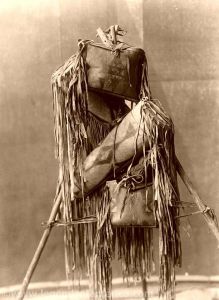
A Native American medicine bag or medicine bundle, upon which this idea is based, is a container for items believed to protect or give spiritual powers to its owner. Varying in size, it could be small enough to wear around the neck, or it could be a large bag with a long strap called a “bandolier.” The size of the bag is determined by how many items need to be carried.

In historical times, medicine men and shamans generally carried a large medicine bundle that could hold numerous items such as seeds, herbs, pine cones, grass, animal teeth or claws, horsehair, rocks, tobacco, beads, arrowheads, bones, or anything else of relatively small size that possessed spiritual value to the bundle’s owner. Warriors also carried bundles that included important items, such as rattles, animal furs, special stones, or anything that meant something to the owner.

Packing to Go.

Check out some comments by people who Packed to Go back in 2005.
Share an image of the bag you pack to come on this Yule Adventure.
What will you pack? Tell us what you are putting in it and how you feel about heading out during this festive season.

Some Creative Medicine Bags

Trick for LearningTarot

Far too many people worry about reading tarot cards the “right” way. There are actually far more helpful reading techniques, depending on the situation. It is also believed that when reading for others the reader must do what the client expects. This all too often means to predict the future and tell people how to obtain their desires. Is the job of a foot doctor to cure lung cancer? As readers we have a right, even an obligation, to discover what we do best and to offer that in readings both for ourselves and for others. The task becomes learning what we do best and offering that with clarity and confidence.

One of the tricks I have found to be very successful is to regularly complete challenges and by using the cards to kick start story telling.

Recently I have been working on a project helping Aussie Wildlife learn about tarot and I have found that drawing Australian wildlife in tarot settings has helped refine my knowledge of the cards

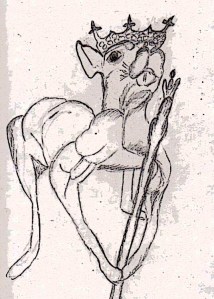
Big Red is the King of Wands

For example, in response to the Tarot Storytelling Spread I drew the Big Red Kangaroo as the King of Wands.

Kangaroo’s are herbivorous. They reside throughout Australia, Tasmania and New Guinea. Kangaroos have powerful, long hind legs and feet for leaping and jumping with. Their long tails thicken at the base to help them balance. Each of their hind feet has 4 toes, this number represents foundations.

This big Red Kangaroo, proudly wearing his crown of authority, has the power to create a safe and secure environment for his mob. The Red Kangaroo has an innate capacity to adapt to new situations and environments. Kangaroos are extremely focused beings, with their energy fields tightly woven around them with no room for distractions. 

If hunted by a Dingo, human or a rare Tasmanian tiger, the Big Reds are very fast and hop effortlessly to safety without a moments thought about where they are going. They use their strong instincts to guide them.

For us humans, there is a great lesson to be learned from this – instead of thinking about every single, most minute step we take we must let our instincts guide us.

A Fools Journey

Once upon a time, long before there was once upon a time, an old crone decided that she needed to make one final creative journey and add another star to the constellation in the skies that shone within her private universe. She was not in the least surprised when a Raven and a Donkey insisted on coming along, for they had travelled with her before.

This image has an empty alt attribute; its file name is img_3949.jpeg

What did startle her was the arrival of a flamboyant, charismatic Sulphur Crested Cockatoo named Bonnie. She suspected that Bonnie was one of the flocks that had raided her beloved Ornamental Pistachio Tree each year because she was quite sure that she had seen and photographed a bird, with attitude, who looked just like her.

Duncan the Donkey made it clear that he was getting too old to carry heavy loads and while the Crone agreed that it would be good to travel lightly she did ask Duncan to carry some of her art supplies and made sure to tuck a few of her Tarot and Oracle cards into her bag. She had relied on them during the long ‘lockdowns’ and wasn’t about to go anywhere without her most trusted ones.

Bonnie’s sharp eye caught a glimpse of these boxed treasures and, because she is such an inquisitive bird, wanted to know more about them. The Crone began to explain the Major Arcana to her and was surprised to discover that Bonnie was more fascinated than any of her human friends had been.

“Perhaps you will teach me about these Majors as we travel” said Bonnie.

“What a good idea” said the Crone. “There is so much that I am yet to learn and we could always learn together”.

A Fools Journey

Brand Bonnie

From the Crone’s Diary

Other material of interest

Interested in Mythic Journey’s? Check out the work of Christopher Vogler and his book The Writers Journey

Writing Portraiture

“The portrait is generally a form of description, and like all descriptions it is a particularly enjoyable device to reread. Anais Nin is the master of descriptive portrait in the diary. Nin made an effort to be fair and free of malice in her word-portraits of friends and acquaintances, though she was aware of weaknesses as well as talents of those she described. In writing portraits she tried to include as many details as possible about herself and the other person”.
Tristine Rainer The New Diary.

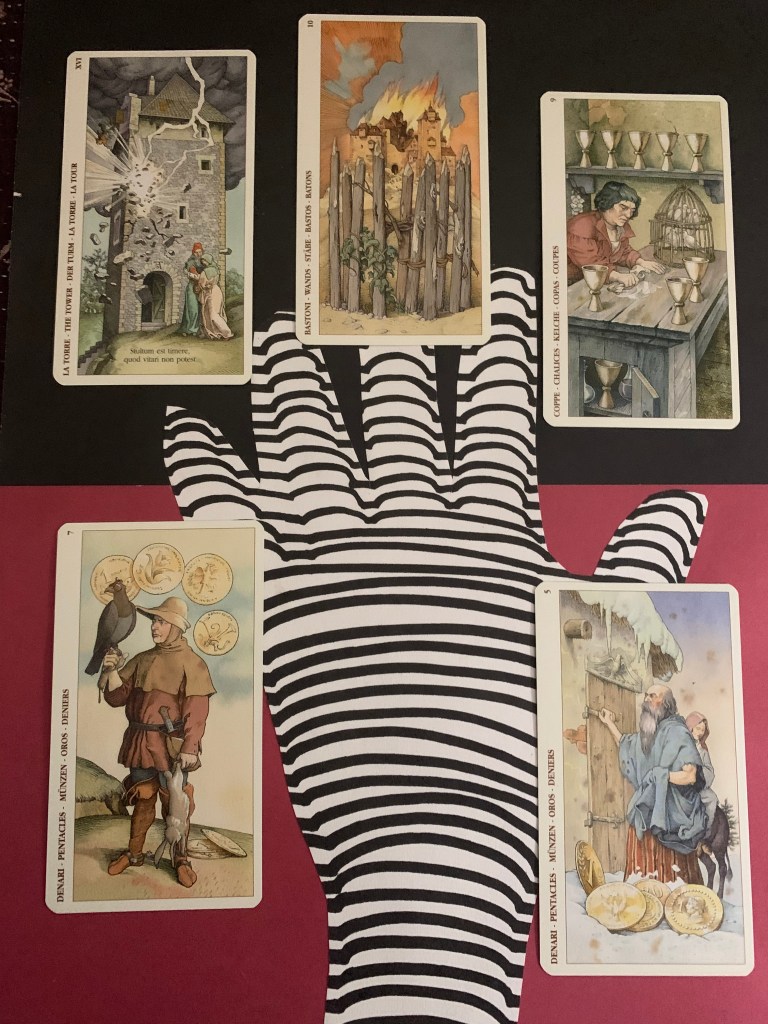
‘The Hand’ is a device I have repeatedly used in writing classes. I have people place their hand on their notebook and draw around their fingers. Then I suggest that they lay down some cards. The card for the thumb is the primary figure for this word-portrait. The other four fingers represent people and events that have impacted on this persons life.

  • Carefully look at the pictures. Make sure to take in as much detail as possible. It is important to look very closely. 
  • What are the different elements? Plants? Buildings? Flowers? Animals? What is the landscape? Are there people in the card? What is the person in the picture doing? What objects do you see? Why do you think they are there? What’s in the background? What’s in the foreground? How do all of these different elements come together into a coherent story?
  • Notice every small and large detail and make a note of it. Absorb the entire card into your mind.
  • Now set your timer for 20 minutes. And start writing remembering that you are not in a writing competition.

“Remember that a portrait done like this is never really finished. You can always recolour it, revise it, contradict it, add to it. The mobile,  evolving quality of the portrait makes it a useful tool in recognizing the psychological process of projection. Rather than just seeing the person on his or her terms you are likely to see a mirror reflection of yourself and gain insights about yourself. By writing portraits you begin to see if the face you are describing is your own”. Tristine Rainer The New Diary

Telling Tarot Stories

Great Tarot readers, like writers, know how to weave the story between the Tarot cards to create highly engaging and meaningful Tarot readings for their clients. They see patterns between the cards and combine these intuitive messages into a beautiful story that is unique to the client and their situation. This exercise is good for writers looking to warm their hand by practicing on a daily basis. It is also a good practice for a tarot reader to strengthen their spontaneous story telling skills

Every Tarot card contains its own unique story and each story can be expanded by using more than one card. Every card in a Tarot deck is connected by an invisible thread.

As writers looking to maintain a daily practice Tarot cards are a wonderful source of inspiration.

Over a cup of tea or coffee one way to start the day is to quietly shuffle a pictorial deck and draw some cards. In this instance I chose the Tarot of the Durer which is an art deck compiled by taking scenes from some of Durer’s famous work. I opted to choose just two cards.

Lay out your cards as I have done here.

  • Carefully look at the pictures. Make sure to take in as much detail as possible. It is important to look very closely. For example, did you notice that the eagle is chained and that there is an ominous raven shaped cloud above the old man in the 10 of Pentacles? What is your impression of Temperance’s mood? How is she relating to the cow? What is her connection to the elderly man in the 10 of Pentacles?
  • What are the different elements? Plants? Buildings? Flowers? Animals? What is the landscape? Are there people in the card? What is the person in the picture doing? What objects do you see? Why do you think they are there? What’s in the background? What’s in the foreground? How do all of these different elements come together into a coherent story?
  • Notice every small and large detail and make a note of it. Absorb the entire card into your mind.
  • Now set your timer for 20 minutes. And start writing and sketching, remembering that you are not in a writing or art competition.
  • Make up a story as you go along. Use the elements from the picture in your story. You can be as creative as you like – just let yourself go wild. Write down a story in the 20 minutes you’ve set aside.

Talking to the Stones

The Philosophers Stone consists of 40 square cards, each depicting a painting by artist De Es Schwertberger, along with a particular quality or condition. Schwertberger’s preferred subjects seem to consist entirely of stones with human faces, stone figures, and stones over plain backgrounds. The artist seems to have applied an enormous talent to an extremely narrow subject matter.

You can dig very deep with these images, it’s almost like looking into a persons’ soul. These cards are ideal for prompting ideas, especially when combined with another deck.

To get a feel for this 1970’s deck begin by watching this walk through by the Tarot Alchemist. Stop and pause the video and meditate upon some of the images.

Get out your journal and see where these cards lead you. Here are some starter activities.

Write a stream of consciousness piece based on how our need to belong, connect and complement one another is being compromised during this 2020 pandemic. Given the current crisis it might be a bit full on to read The Masque of the Red Death by Edgar Allen Poe but right now it does seem to resonate. Here are some exercises I have used after reading the opening of this story.

Card 28 Portrays Existence and when I viewed this image my thoughts turned to Sisyphus who was punished for his self-aggrandizing craftiness and deceitfulness by being forced to roll an immense boulder up a hill only for it to roll down every time it neared the top, repeating this action for eternity.

Your thoughts may go else where. Perhaps you might take the time to interview this figure and write the dialogue that emerges.

More Ideas

This stone, lying in an old goldfields park has witnessed enormous change in the world.

Take a walk sometime, watch for a stone that seems to grab your attention… pick it up, turn it over a few times and look for images on it’s surface. Allow those images to relay words to your mind. Those words will be the message from the stone – for you. This a simple form of stone divination, looking and listening within – to dive in – “divine” an answer to a question.

Quietly enter the world of Stonehenge. Stand in the centre of these famous stones – one of the wonders of the world and the best-known prehistoric monument in Europe – and dialogue with these ancient stones.

Remember that while the mysteriously arranged structure of Stonehenge is one of the world’s greatest wonders these odd stone arrangements can be found throughout the world in many shapes and sizes. Known as megaliths, these giant stones formed prehistoric structures in amazing (and perplexing!) feats of construction. The purpose of these sites may be shrouded in mystery, but their remains add character and ancient beauty to landscapes across the globe, from the cold mountains of Russia to the balmy Mediterranean. Take the time to visit 7 ancient megaliths.