Now it is candles, nubby woolens, shearling slippers, woven textiles, pastries, blond wood, sheepskin rugs, lattes with milk-foam hearts, and a warm fireplace. Hygge can be used as a noun, adjective, verb, or compound noun, like hyggebukser, otherwise known as that shlubby pair of pants you would never wear in public but secretly treasure. Hygge can be found in a bakery and in the dry heat of a sauna in winter, surrounded by your naked neighbors. It’s wholesome and nourishing, like porridge; Danish doctors recommend “tea and hygge” as a cure for the common cold. It’s possible to hygge alone, wrapped in a flannel blanket with a cup of tea, but the true expression of hygge is joining with loved ones in a relaxed and intimate atmosphere.
Of course it is easy to get carried away with this Hygge thing. It is a bit like Catnip to those selling socks and all the other items associated with Hygge! Everyone has such brilliant suggestions about how to get into the mood. For example, Moody Moons offers some ideas about how to Hygge like a Witch.
The bottom line is that Hygge is all about self nurturing and it is no state secret that many of us are not so good at caring for ourselves.
This post is all about ‘the deck’ that is the one you will turn to when you need to self soothe.
So pull out the comfie socks, set yourself up by the fire place, toast some marshmallows and Chill It with your most soothing decks.
Try doing a Self Love Spread – there are tons of these to be found on Pinterest.
The deck I will turn to is a recent acquisition. It is Into the Lonely Woods by Lucy Cavendish and Dan May. But others that always offers comfort are The Arboridium and the Oracle Deck I created using images from fantasy magazines and second hand children’s books.
Over to You
What is your reliable self soothing deck, the deck you turn to when you need to be comforted or cheered up? Share photos of your deck and your Hygge space.
If you don’t have the right Hygge deck get out the craft supplies and spend quiet time making one for yourself
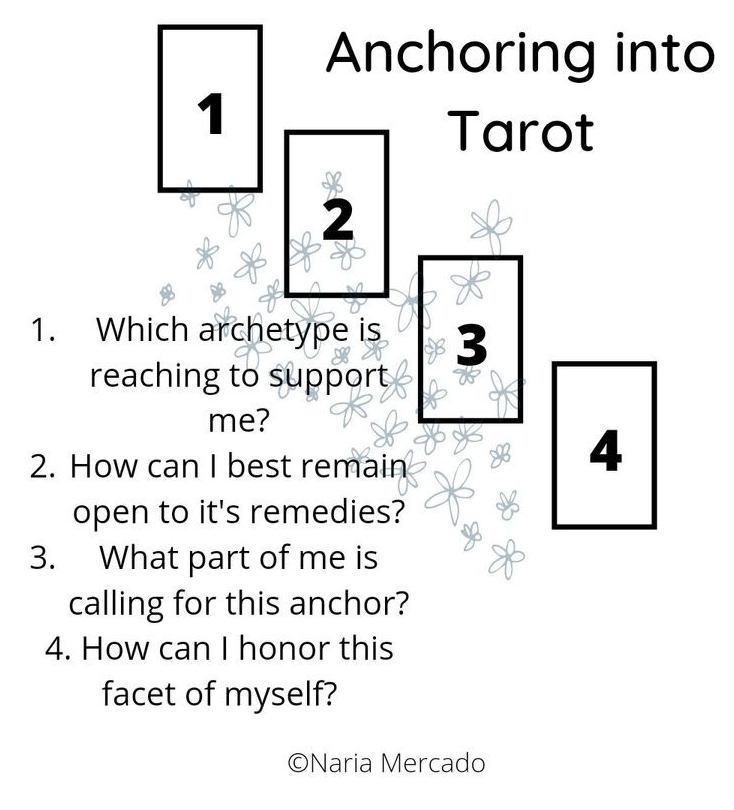
2 : someone or something that provides strength and support He is the family’s anchor. anchor. verb. anchored; anchoring. Kids Definition of anchor (Entry 2 of 2)
anchor something to fix something firmly in position so that it cannot move Make sure the table is securely anchored. [transitive, usually passive] anchor somebody/something (in/to something) to firmly base something on something else Her novels are anchored in everyday experience.
a person or thing that can be relied on for support, stability, or security; mainstay.
Carl Jung, a Swiss psychiatrist from the 20th century, was the first person to bring the application of archetypes into modern psychology. Jung noticed that people and life situations are marked by primary patterns reflected in symbols, images, and themes common to all cultures and all times. We see archetypes as recurring images in art, literature, myths, and dreams. Mother, Father, Home, Stranger, Betrayal, Anger, Love — these are all archetypes expressed in characters, stories, images, and symbols in all cultures and all times, and, these are all universal experiences in human life.
Identifying which archetypes are influential in our lives can thus lead us to self-discovery, self-awareness, growth, and self-actualization. Consciously choosing the right archetype for each chapter in our life story can create a more fulfilling, successful life, where we use our archetypes instead of being controlled by them.
Reasons to work with archetypes
Increasing self-awareness
Finding greater fulfillment and meaning in life
Improving personal, family, community, and workplace relationships
Expanding abilities, perspectives, and options
Helping people to escape habitual archetypal patterns that have become limiting ruts rather than empowering paths
Enabling people to be actively engaged in charting the course of their journeys
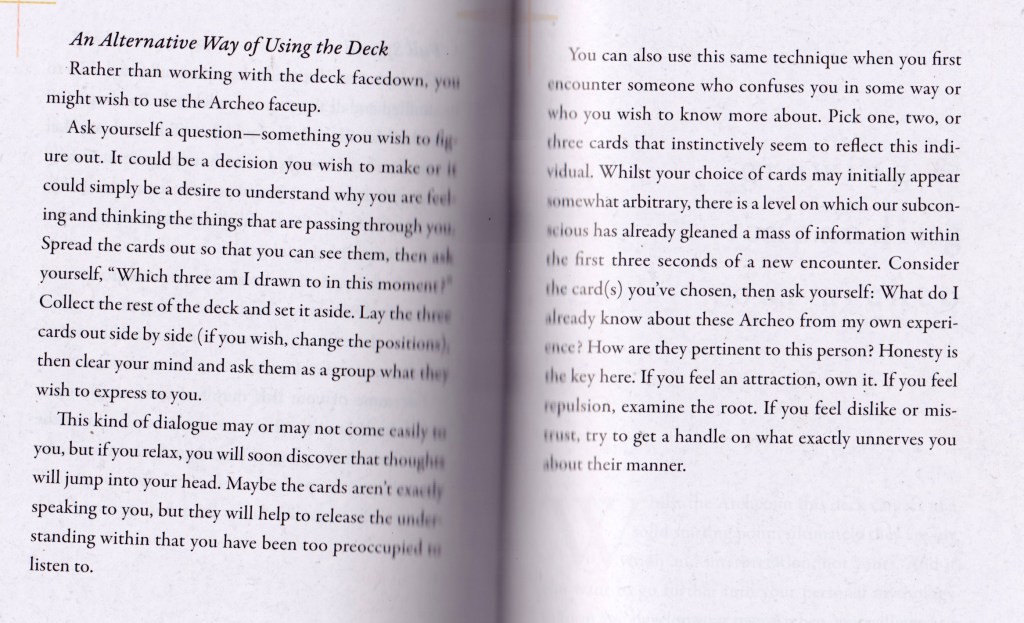
Aside from checking out the archetypes in the Tarot there are specific decks which help us work with these aspects of self. Two decks that come to mind are the Archeo by Nick Bantock and the Archetype Cards by Carolyn Myss. These are a fantastic resource for personal reflection or for working with characters if you are writing or making art.
Nick Bantock provides a number of spreads and ideas for working with Archetypes. Here is just one of those.
Another way to work with Archetypes is to ask a Show Me Deck what one needs to consider. My extension deck which includes Shadow Cards called on me to work with a ‘bad trait’. Now I don’t happen to believe any trait is completely bad and so it was no surprise when the ‘Eccentric’ emerged. It is not bad to be eccentric but it can alienate us from others.
So I decided to explore a simple Past, Present, Future spread using my most eccentric deck and low and behold its all there to show me how ingrained this archetype is.
In 2018 I did a ‘Danse with the Macabre’ when I visited Sedlec Ossuary (aka Kostnice Ossuary Beinhaus). It was one of the highlights of my week long stay in the Czech Republic.
“Known to most as “the Bone Church,” it displays some of the world’s more macabre art. In addition to a splendid bone chandelier composed of almost every bone in a human body, the ossuary displays two large bone chalices, four baroque bone candelabras, six enormous bone pyramids, two bone monstrances (a vessel used to display the Eucharistic host), a family crest in (you guessed it) bone, and skull candle holders. Festively looping chains of bone are hung throughout like crepe paper at a birthday party.”
Atlas Obscura
In the Danse Macabre, or Dance of Death, skeletons escort living humans to their graves in a lively waltz. Kings, knights, and commoners alike join in, conveying that regardless of status, wealth, or accomplishments in life, death comes for everyone. At a time when outbreaks of the Black Death and seemingly endless battles between France and England in the Hundred Years’ War left thousands of people dead, macabre images like the Dance of Death were a way to confront the ever-present prospect of mortality.
Though a few earlier examples exist in literature, the first known visual Dance of Death comes from around 1424. It was a large fresco painted in the open arcade of the charnel house in Paris’s Cemetery of the Holy Innocents. Stretched across a long section of wall and visible from the open courtyard of the cemetery, the fresco depicted human figures (all male) accompanied by cavorting skeletons in a long procession. A verse inscribed on the wall below each of the living figures explained the person’s station in life, arranged in order of social status from pope and emperor to shepherd and farmer. Clothing and accessories, like the pope’s cross-shaped staff and robes, or the farmer’s hoe and simple tunic, also helped identify each person.
The Death card is one of the most feared and misunderstood cards. Spread by movies trying to sensationalize drama and abused by the occasional unscrupulous reader, the Death Card strikes fear into the heart of anyone who doesn’t understand it. The Death card frightens many people, for they think it means that they, or someone they love, is going to die — although when they hear it signals great change, they can become frightened of that, too, even if they need it.
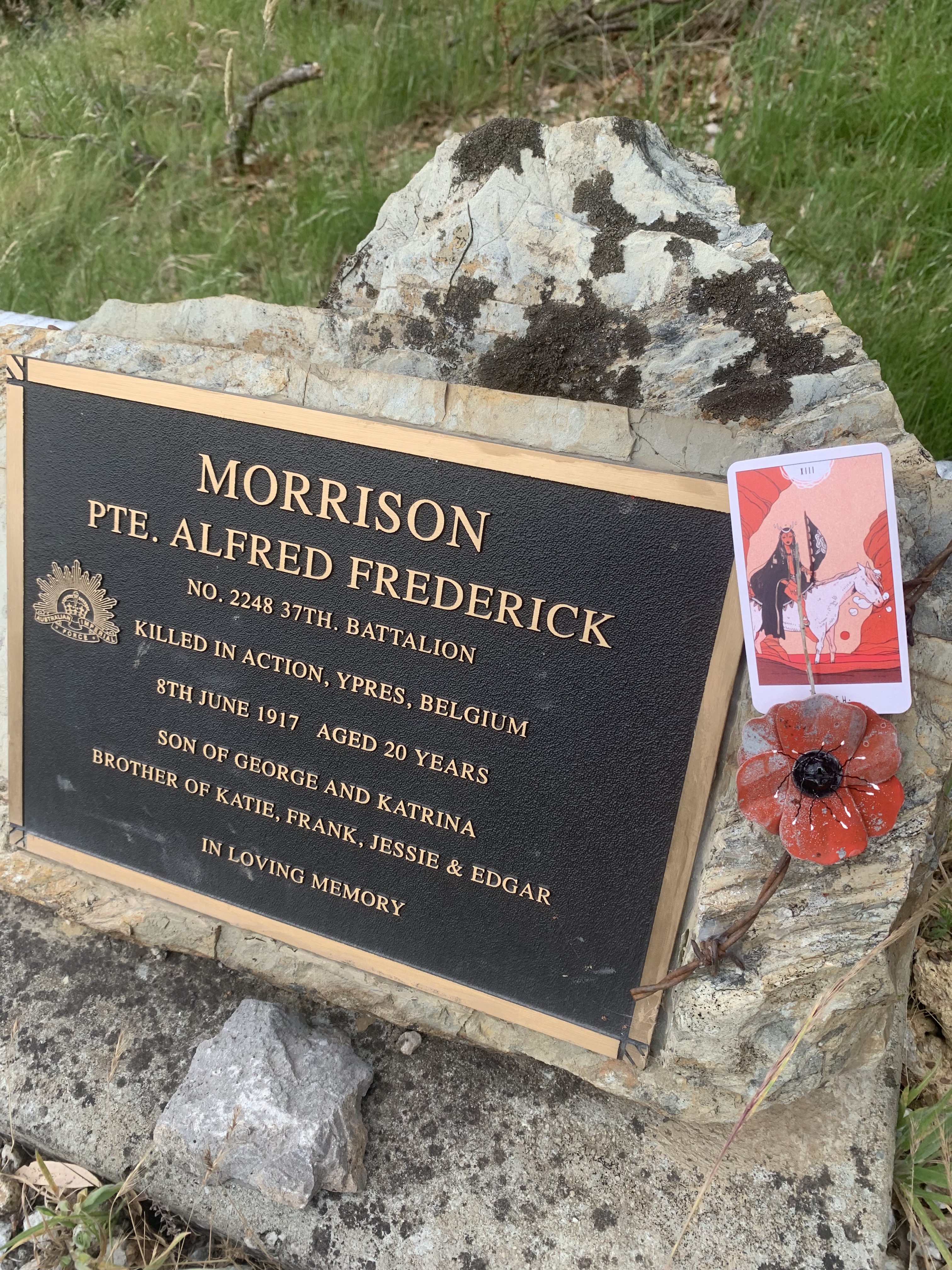
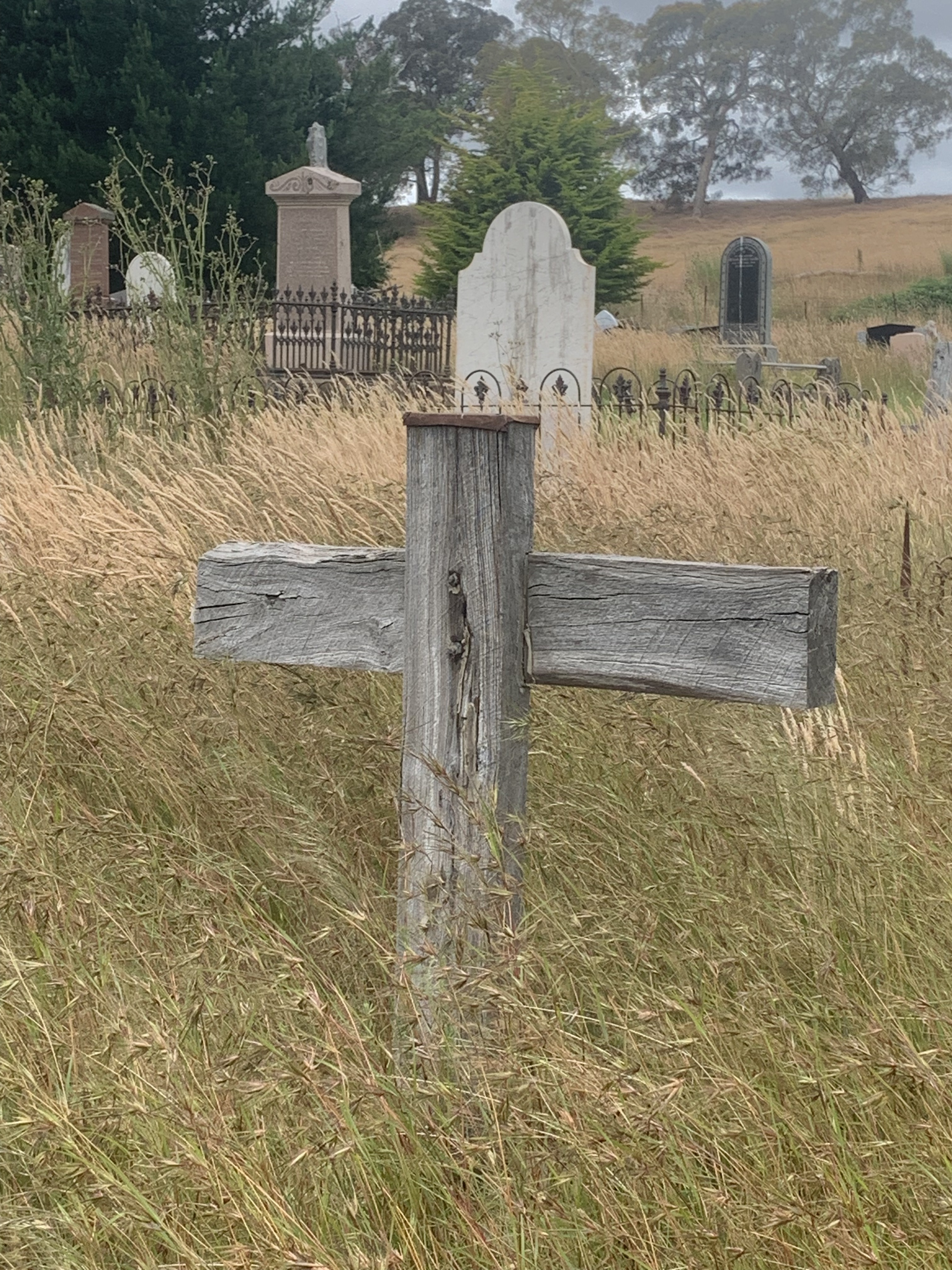
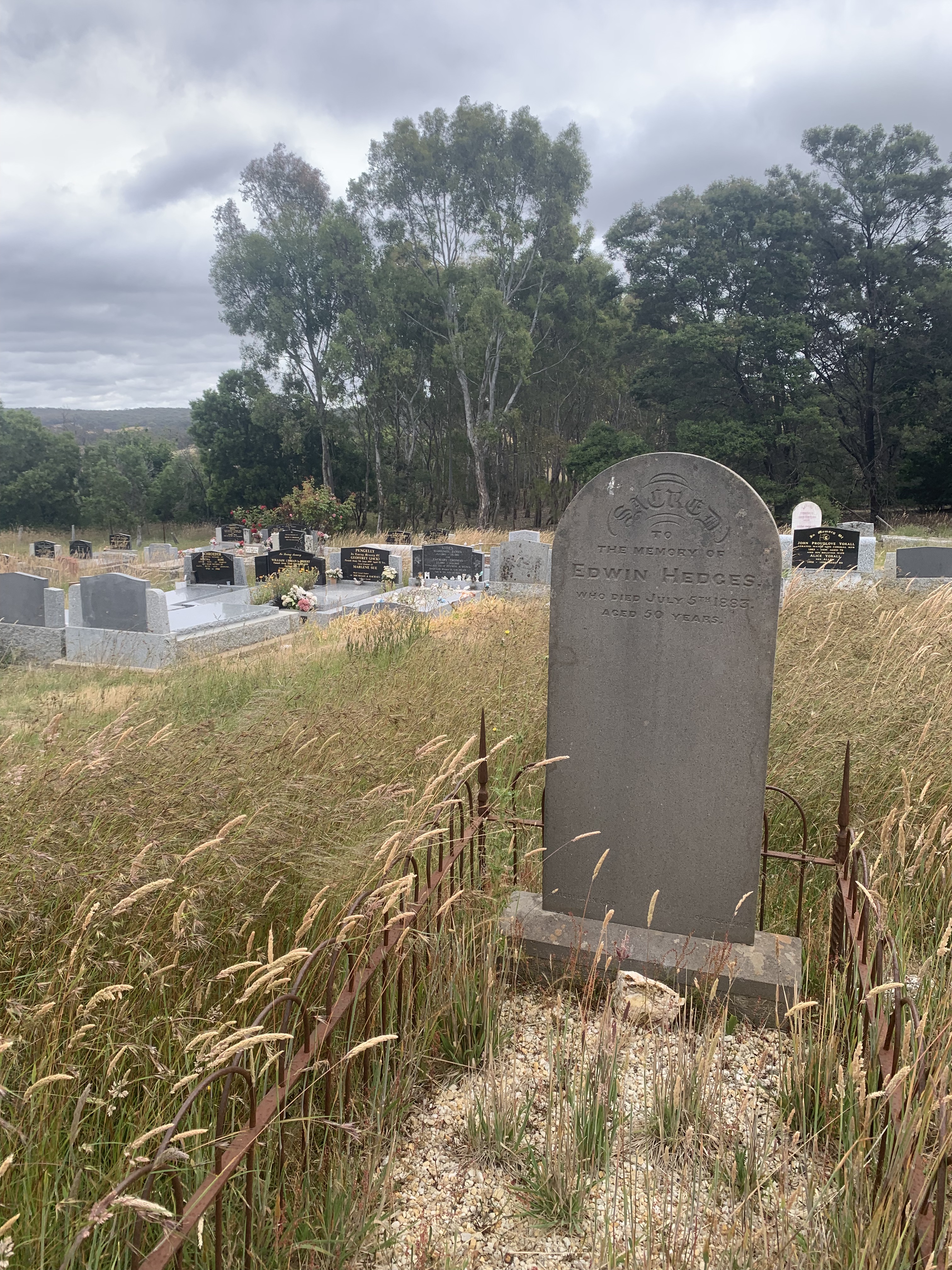
Rather than fear the Death Card embrace it by taking a deck of cards and visiting a cemetery like the one I visited in my region.
I stopped at the headstone, erected for Pte Alfred Frederick and contemplated the impact of his death at just 20 years of age, the utter waste of war. All around me was evidence of change, which is actually what the Death Card is all about.
Over to you
Lay out some Death Cards and meditate on the message
Consider taking the opportunity to ‘Danse Macabre’ by visiting a cemetery with a deck of cards and doing this spread.
So you’ve decided you love Tarot and Oracle, but you can’t quite find a deck that resonates with you. Or perhaps you’ve found some that are okay, but you really want to tap into your creative spirit and make a custom deck of your own.
Creating your own set of cards lets you understand what each card means and how you can interpret it during readings.
Can you do it? Of course you can. The most challenging part is finding the images.
Many people have made Tarot cards throughout the course of the centuries. You can purchase blank ones in a set, already cut and sized for you, and create your own artwork to go on them. Or you can print them out on photo paper or card stock and cut them yourself.
Years ago I facilitated a group who exchanged Trading Cards and I have a lovely box filled with ones that were sent to me.
During a 2020 lock down I made a set of my own Oracle cards. I had an incomplete deck I had picked up in a Charity store and I repurposed this card stock using images from old fantasy art magazines that I had. Because I am using the imagery of artists whose work was featured in those magazines, I make it very clear that this deck is strictly for my personal use.
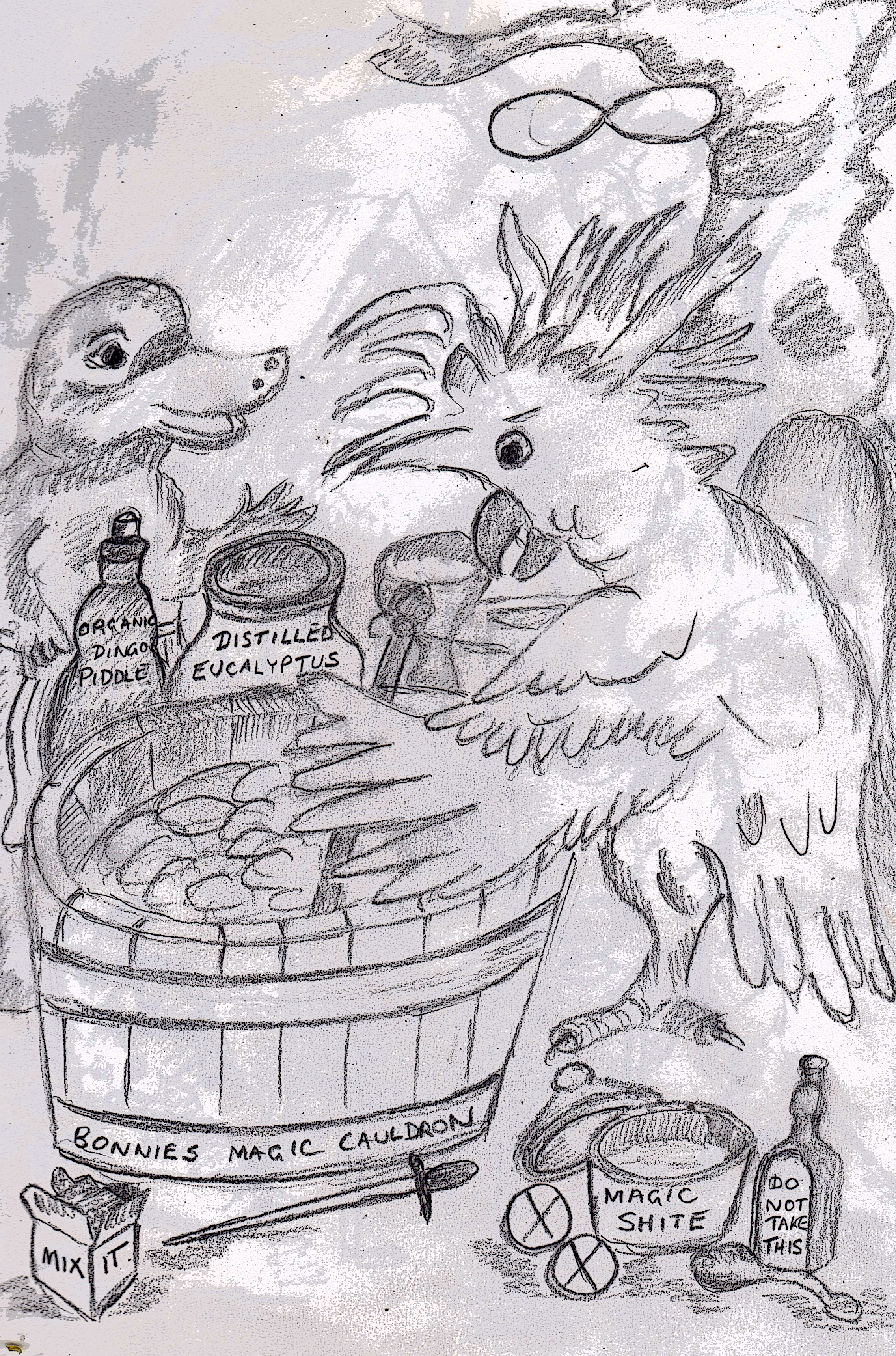
It was more challenging to draw the 78 cards for Bonnie’s Skool of Tarot but it certainly helped me learn more about the meaning of each card.
The FoolAce of WandsFive of WandsThe MoonThe MagicianThe Hierophant
I think I am not the only one intrigued by the picturesque of early Tarot cards. What do they really represent? Who drew them? Who put all these icons together?
Then I saw Dario Fo, the great Italian comedian of Comedia dell Arte, play writer and Nobel Prize winner, acting on stage playing the hilarious figure of a barbarous Pope (I cannot recall who) and I thought that something of the medieval feasts, mysteries and banquets were radiating from the stage… from Origins of the Tarot Cards from Medieval Mystery Play
Whether you are an experienced Tarot reader or a beginner there is no doubt that lovers of cards love to play with their cards. This Advent Calendar is primarily about spending time with and playing as though you are playing with a good friend.
Hudson explores, in some detail, the history of Mystery and Morality Plays
As early as the 14th century artists were painting the heroes of Miracle, Mystery and Morality plays on to cards. In his book, Mystical Origins of the Tarot, Paul Hudson explores the ancient roots that lie within these plays.
Typically, Morality plays, for example, tried to teach through a theatrical point of view. These plays were allegorical dramas that personified the moral values and abstract ideas to teach moral lessons. The plays were used to educate the masses on Christianity.
A unique dance production featuring the deck of 22 cards, in their traditional order, is just an example of how artists make use of the Tarot.
Here is a setting for a Medieval Style Play using a Magnetic Theater my daughter had as a child.
Imagine you are writing for a Medieval Theatre Troupe. What cards would you choose to use for a play set in a Royal Court or conversely for a Chaucer, Canterbury Tales style character like the Wife of Bath? Check the link to be reminded of the characters that peopled Chaucers work.
Bonding with your tarot deck is a great practice you can use, along with cleansing your cards, to attune to your new, or old, deck’s vibe for more powerful and accurate readings.Search online and you will find plenty of suggestions about how to connect with your deck. Here is just another fun suggestion.
In this instance I have used the Cosmic Tarot, and chosen the Princess of Cups to be the primary protagonist.
One way to build up your connection with Tarot decks is to use the suits and court cards to tell spontaneous stories.
There are many advantages of using the storytelling process to connect with your Tarot cards.
You really get into the picture of the cards and observe the details of the imagery.
You can really internalize each and every aspect of the card’s pictures.
You can get creative and let your imagination run wild while writing the story.
its an opportunity to let imagination and Intuition mix really well together
Lay out a full suit from your Tarot deck and choose one of the Court Cards to take the role of primary protagonist.
Set a timer for twenty minutes and just write.
Here is an example of a tale, written in twenty minutes, using the Cosmic Tarot for inspiration.
After having been through a trying time, having emerged from a sustained period of loss and grief, Sonia, a young Princess in the House of Cups, visited a local Gypsy tarot reader. The Gypsy told Sonia that her cup was actually overflowing with potential and suggested that she might try to find delight in life by observing simple things. She told the Princess that this would sweeten her life and open her up to positive experiences.
Sonia took the Gypsies advice to heart and began to take more notice of her environment. In no time she began to see the world of the palace in a different light. She watched her mother, Queen Isobella working tirelessly in the Court gardens. Sonia decided that instead of sitting by her window, waiting for yet another, disappointing, entitled, narcissist prince to come, she would take her art supplies and slip into the Enchanted wood that she had loved as a child.
As the days passed her demeanor transformed and her parents and brother noted her flushed cheeks and the transformation that had taken place. Sonia suggested that it was all due to the fresh air and her passion for her artistic endeavours. What she did not reveal, over the formal evening dinners, was that while she was in the woods she had met a very handsome huntsman and that each day she was making sure to set up her easel where he would find her.
Dressed as a maiden, the huntsman was oblivious to her true identity. He began to court her, finding small gifts to give her each day. Gradually she filled her box of wonder with delightful fragments, stones, gum nuts, flowers, feathers and crystals. Each piece had a story to tell and the fairy folk of the woods unashamedly supported their affair and shielded their passionate love making from prying eyes.
Alas, one day, courtiers, at the behest of the King, followed her and witnessed her meeting and walking off with the huntsman. After Sonia had returned to the court, flushed after her encounter, the courtiers returned to the woods and revealed Sonia’s identity to the huntsman. They threatened him and made him understand that he best make himself scarce for he was not eligible to marry her.
The huntsman, knowing their lives were in danger disappeared and Sonia fell into despair when he failed to meet their rendezvous. In desperation she went back to the Gypsy, seeking more advice.
The Gypsy, upon seeing the empty cups in the spread, pointed instead to the ten of cups and reassured Sonia that happiness could still be hers.
Being a determined young woman Sonia sought help from the Fae folk and was taken to the Huntsman’s cottage deep within the woods. They talked for hours, imagining the life they could share if she was prepared to relinquish her royal life and live with him in this idyllic woodland setting.
He was shattered when she made it clear that this was not possible, that her family, the courtiers would literally hunt them down and kill him for his insolence.
It seemed that all was lost until her mother, with a group of her Ladies in Waiting appeared before them. The Queen recognized the huntsman as the youngest son of her brother, the King of the House of Swords. King Eric had sent the lad into the woods to learn about life, to learn to honour all living things and he had been gone so long he had quite forgotten who he was.
Needless to say, sensing that Sonia was already with child, Queen Isobella wholeheartedly blessed the union, even although they were cousins.
To celebrate their marriage Sonia commissioned an artist to paint a portrait of herself. Everyone was taken aback when they saw that she had posed naked in the woods, surrounded by Fae folk and overflowing cups to celebrate that her cup runneth over – at least for now.
All Tarot and Oracle Deck collectors will have at least a couple of decks that they have disconnected from. Yule is the time when many people reconnect with friends and family. If we think of a deck as a person who we have a relationship with it might just be time to reconnect. It may sound slightly crazy but you can take the time to hold the deck and explain why you’ve been out of touch. You might briefly describe what has been going on with you if you must explain your disappearance, but don’t put yourself down. No mea culpa about how bad or shameful you are. Just reconnect — don’t try and solve all the relationship issues of the past.
Engaging in the challenges that appear in the Instagram Community is a great way to reconnect, build a relationship with your deck and develop your tarot reading skills all at the same time. There are a vast number of challenges to choose from and most can be done at your own pace.
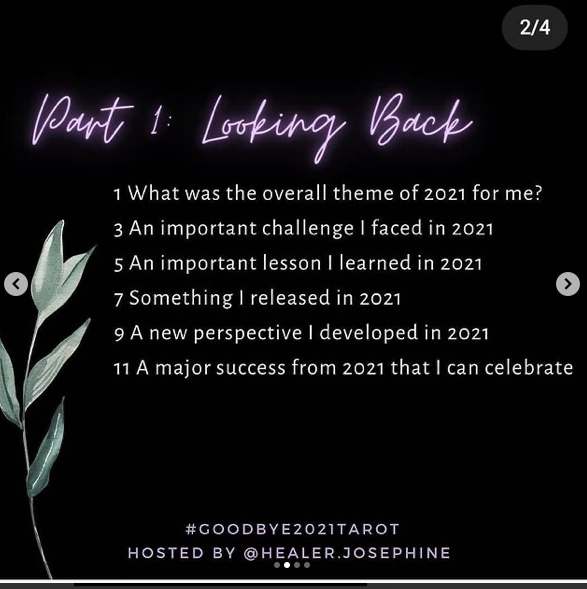
Two that have caught my eye this month are Deckember 21, which encourages participants to showcase their favourite Majors and Inner Landscape of the Dark which provides a way to mine your inner landscape.
Personally I love to work with Josephine Hardiman’s Challenges. She consistently posts thought provoking work which you commit to doing every second day. Her latest is the Goodbye to 2021, which is very appropriate for December.
Over to You
The Lions Gateway Tarot by Jessica Henry who has a new edition available.
The Lions Gateway Tarot is a beautiful Indi deck which I ordered in 2020 before the cost of postage spiraled out of control. I was very excited to get it but it has languished as, like a Wattle Bird I have taken off the feed on what has appeared to be juicier nectar.
I am not in to making New Year resolutions but I am prepared to adopt a different view with the decks I have in my collection and commit to building a closer relationship with them.
Identify a deck you are prepared to reconnect with and spend some time completing a challenge with this one deck.
The King and Queen of Hearts were seated on their throne when they arrived, with a great crowd assembled about them—all sorts of little birds and beasts, as well as the whole pack of cards; the knave was standing before them, in chains, with a soldier on each side to guard him; and near the king was the white rabbit, with a trumpet in one hand and a scroll of parchment in the other. Alice in Wonderland
As the Moon rose, casting its light on the world of the Weasels Pond there was a sudden noise behind us. A small infantry, comprising of all sorts of wildlife, surrounded me, demanding to see my passport. When I couldn’t produce one I was unceremoniously marched off to the Royal Palace and chained up in a dank cell. I remembered Gulliver, who was imprisoned by the Lilliputians when he first reached the island because they were frightened by his massive size. I hoped things here could be quickly resolved. However, the Weasel, who was supposed to help me squeeze out of sticky situations, had been charged with being an accomplice, was no where to be seen.
Bereft I sobbed and wailed at the indignity of it all, at my stupidity. What fool encouraged me to clamber into this alien world? I could be tucked up in the safety of my home, but no, I had decided to join what was promoted as an adventure. Shivering and shaking in a dank prison is certainly not my idea of an adventure!
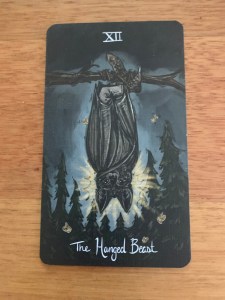
The Hanged Beast from the Northern Animal Tarot
Suddenly the silence was broken by a gruff voice who literally yelled out demanding that I get a grip and shut the horrible wailing noise.
Startled I looked around to identify who was reprimanding me so harshly. As my eyes adjusted to the darkness I spied a beast hanging upside down in a corner.
Now some folk would stain their underwear when finding themselves confined with a Hanged Beast, but not me! I was relieved to find I have a companion, even if that companion was decidedly gruff.
I thought of the Guided Tarot imagery that I sometimes listen to and I decided that I could interview this creature and glean some advice. A Hanged Beast was sure to have some timely suggestions for me about what kind of energy, what kind of action is needed to extricate myself from this prickly situation.
As the Hanged Beast took in my overtures he barely moved. He seemed completely at ease hanging upside down.
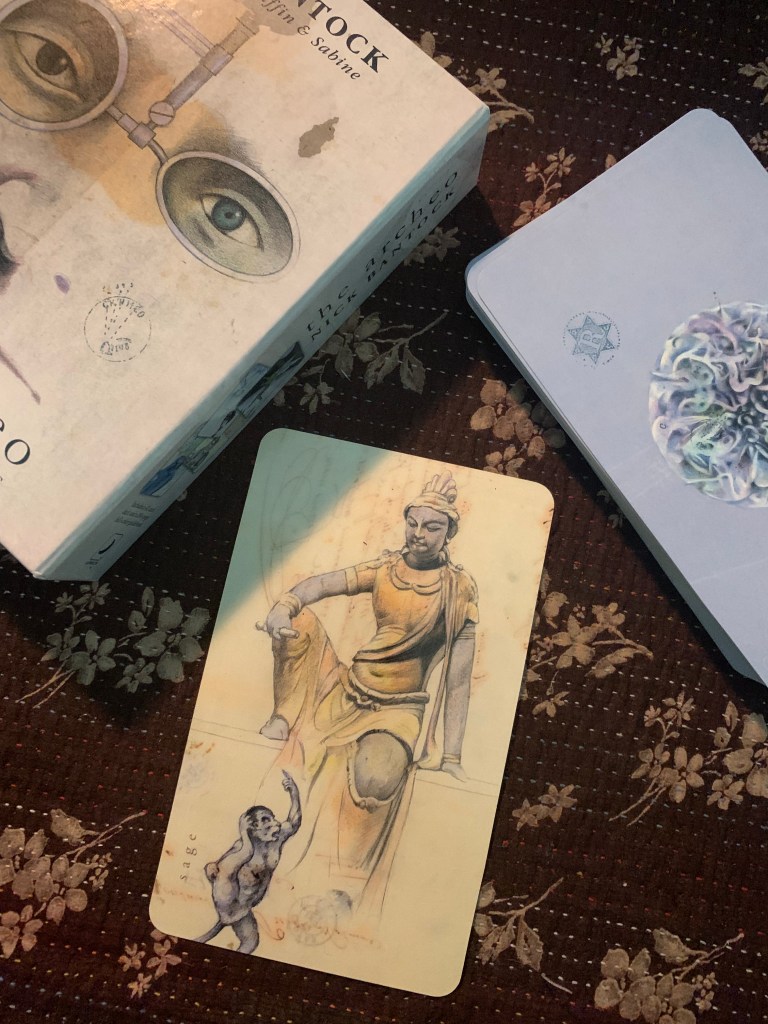
“Why don’t you use that new deck, the Archeo, to determine what kind of energy you actually have that you need to manifest” he dryly suggested.
I was confused! This deck was back at home in my work space there.
The Hanged Beast smiled a knowing smile. “This is a magical place. We can beam it up for you” And with that I found the Archeo sitting next to me.
I drew a card! It was none other than the Sage who reminded me to pause and quietly meditate upon my situation.
Over to You
Christopher Vogler has written in depth about the stages of the Hero’s Journey, which is what we have probably embarked on. Every traveler is invariably confronted with a number of challenges. Tarot decks take us on these archetypal journeys and have become invaluable tools for writers and artists alike. Then, of course there are some outstanding Archetype decks like Archeo by Nick Bantock and Archetype Cards by Carolyn Myss.
Choose a deck from your collection. Enter it and wander for awhile.
What challenge are you faced with?
Which Major or Archetype helps you shift your perspective and move forward?
“Unhurt, Alice gets up and catches sight of the White Rabbit as he vanishes around a corner. Alice approaches a long corridor lined by doors. The doors are all locked, so Alice tests them with a key that she finds on a glass table. After searching around, Alice discovers a small door behind a curtain”.
Within moments of deciding to join this Yule Expedition, seeking the creative grail or elixir of creativity, you pass through a special portal and enter an imaginary world.
As you step into this new world you are greeted by a figure who gives you a special bag filled with talismans for your journey. In your bag you will find a packet of dream seeds, spectacles, a candlestick, a tiny anchor, a medallion with the imprint of the Unicorn and a set of wings. Each bag contains something that has been chosen specifically for each recipient.
Do not misplace this bag or let anyone take it from you. Keep it with you at all times.
Establishing Your Personal Setting
Most of The Lion, the Witch, and the Wardrobe takes place in the fantastic land of Narnia, which Lucy and her siblings reach through—you got it—a magical wardrobe.
Narnia is everything we’ve come to expect from a fantasy novel. It’s a vaguely medieval place in which people live close to the land, fight using bows and arrows and swords, and are ruled by kings and queens who live in palaces. Mythical creatures populate it – not only the stock characters of today’s fantasy world like centaurs and dwarves, but more Greco-Roman-feeling characters too, like minotaurs and dryads.
A master class writing website explains that as a writer, you might be tempted to dive right into your plot and start giving detailed character description of the figure who gave you the bag of talismans. Such a character and this story “needs a space in which to exist—that space is the setting. Taking the time to properly describe your setting will give your book more vibrancy and keep your readers engaged”.
So many of the tarot and oracle decks that we love provide us with rich setting. I look at the pile I have bought with me and I know that I can apply path working, meditation or guided imagery techniques with either the exquisite Arboridium Oracle or Tarot of the Sweet Twilight. I know that these decks will ignite my imagination and help me describe the world I have entered.
Arboridium OracleTarot of the Sweet Twilight
Choose a pictorial deck to spend some quality time with. You literally wander inside the image and drink in as much detail as possible.
Using scrap paper get down as many ideas about the environment you find you in as possible. Keep it simple, don’t set unrealistic expectations, include sketches and experiment with using all your senses.
Make this world come alive through writing or your favorite artistic medium. Share with us what you see, hear, smell, sense, taste, feel or simply make a card depicting the world you are entering.
You have permission to do whatever you like.
What Others See
When I stepped through the portal I found myself in a Gypsy encampment (Gypsy Palace Tarot) and was greeted by some very colorful characters.
I stopped to listen to a poets reading.
Like you, I can remember other days, The early morning air so fresh and clean, Caravans as bright as popinjays, Moving through a world forever green. They called us vagrants in those days, my friend, And what were we but entertainers, Travellers on a road that has no end.
Like you, from crossroad dance to county fair, I followed the road wherever it might lead, From country byways to the city square, From lake to shore, and always we were free. They called us vagabonds and rogues, my friend, And what were we but entertainers, Drifting in an ocean without end.
That’s why we thought we knew each other well, Even though we’ve never met before; What you and I know only we can tell, Of days of freedom lost in gypsy lore. The world may change, but we do not, my friend, For what are we but entertainers, Voices in a song that has no end.
In the distance you hear the sound of their laughter, Of tales told and of drink and of dance, It lures, entices and enchants you In to the heart of the gypsy’s night camp.
Far away from the crowd are hung blankets a small fire burns bright on its own Shadows of a woman are seen clear in the night As she holds herself and she dances alone
She steps toward the light of the fire, To reveal such a haunting, pained face How sad is this woman called Sadie Dancing alone in her black satin and lace
In her tent she reads cards for the strangers As the candles burn dim on the shelf Black Sadie sees into their futures, She helps others but can’t save herself
The pain buried so deeply inside her Makes her live in a world all her own Where she feeds it and nurtures it lovingly, She can heal it, but won’t leave it alone
She falls to the ground crying into the night For the girl who once danced not alone, For what she once was, before pain touched her heart For the man, and the life she had known
Her silenced soul screams at the tools of her trade Telling fortunes, for her, hold no place The crystals and tarot are just symbols of fate, Not the real, not the pain she must face
She backs once again into the shadows Where no one can reach her dark place She hides in the folds of her dresses And tears soak her black satin and lace.
Alice was beginning to get very tired of sitting by her sister on the bank, and of having nothing to do: once or twice she had peeped into the book her sister was reading, but it had no pictures or conversations in it, `and what is the use of a book,’ thought Alice `without pictures or conversation?’
So she was considering in her own mind (as well as she could, for the hot day made her feel very sleepy and stupid), whether the pleasure of making a daisy-chain would be worth the trouble of getting up and picking the daisies, when suddenly a White Rabbit with pink eyes ran close by her.
There was nothing so very remarkable in that; nor did Alice think it so very much out of the way to hear the Rabbit say to itself, `Oh dear! Oh dear! I shall be late!’ (when she thought it over afterwards, it occurred to her that she ought to have wondered at this, but at the time it all seemed quite natural); but when the Rabbit actually took a watch out of its waistcoat–pocket, and looked at it, and then hurried on, Alice started to her feet, for it flashed across her mind that she had never before seen a rabbit with either a waistcoat-pocket, or a watch to take out of it, and burning with curiosity, she ran across the field after it, and fortunately was just in time to see it pop down a large rabbit-hole under the hedge.
In another moment down went Alice after it, never once considering how in the world she was to get out again. Chapter 1 Alice in Wonderland
The door may appear locked but if you say the right words it will magically open and you can join a Yule Adventure.
It is recommended that, unlike Alice, you spend a little time thinking about what you are going to need. Think about what you would pack in a creative medicine bag to carry, to protect you as you wander in strange new worlds.
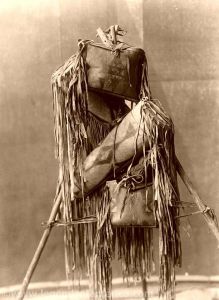
A Native American medicine bag or medicine bundle, upon which this idea is based, is a container for items believed to protect or give spiritual powers to its owner. Varying in size, it could be small enough to wear around the neck, or it could be a large bag with a long strap called a “bandolier.” The size of the bag is determined by how many items need to be carried.
In historical times, medicine men and shamans generally carried a large medicine bundle that could hold numerous items such as seeds, herbs, pine cones, grass, animal teeth or claws, horsehair, rocks, tobacco, beads, arrowheads, bones, or anything else of relatively small size that possessed spiritual value to the bundle’s owner. Warriors also carried bundles that included important items, such as rattles, animal furs, special stones, or anything that meant something to the owner.
Packing to Go.
Check out some comments by people who Packed to Go back in 2005. Share an image of the bag you pack to come on this Yule Adventure. What will you pack? Tell us what you are putting in it and how you feel about heading out during this festive season.
Some Creative Medicine Bags
Despite being accustomed to traveling lightly, Rosie the Red back Spider responded and packed a small bag with some special talismans.














 The Tarot Midwife