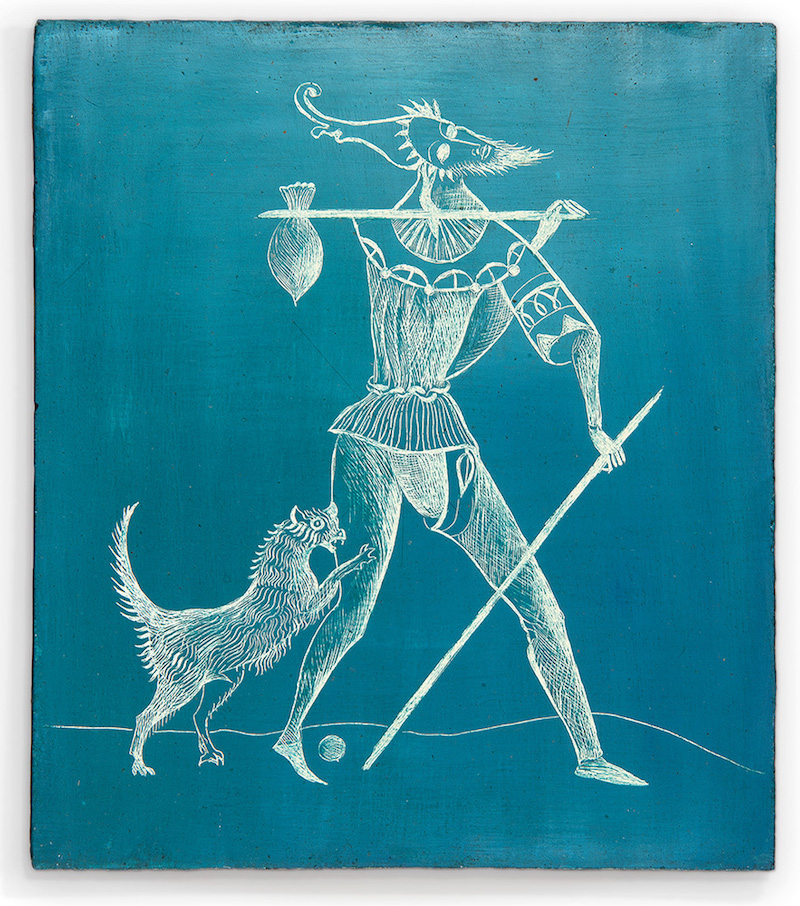
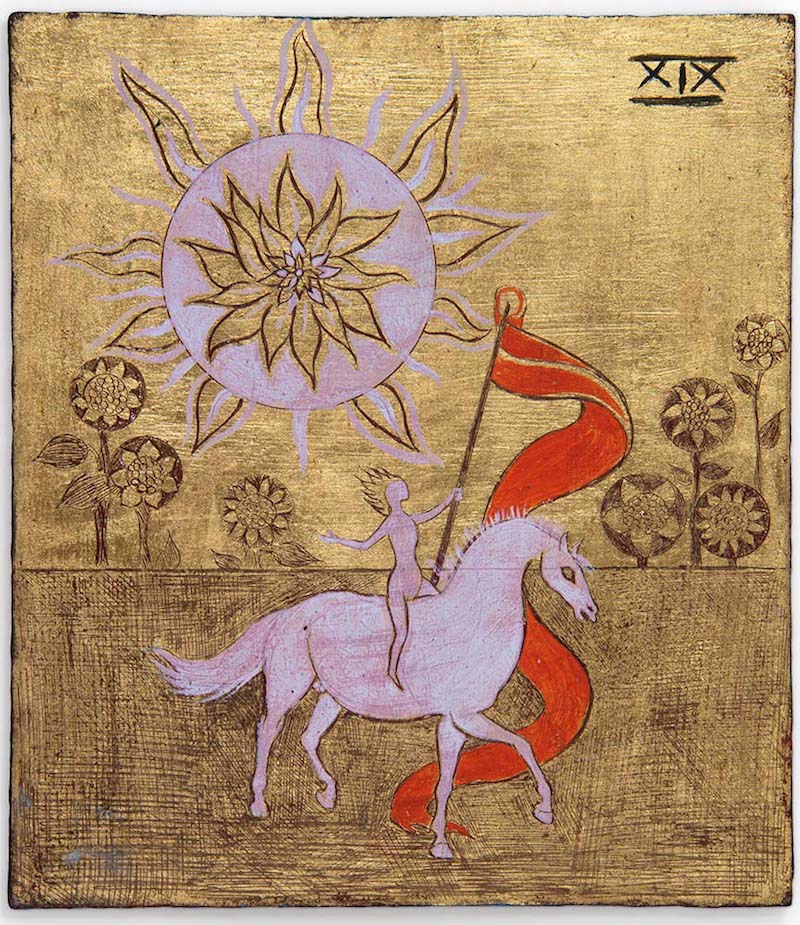
Leonora was a restless voyager through deep journeys, always in quest of mythic revelations. Her aim was to repair a shattered world and a means to live in it, unearthing the many images that came her way. Guided by her intuitive meanderings she came upon the I Ching or Book of Changes, carving beautiful wooden tokens and dwelling on the secret language of hexagrams to reach her own patterns of change. She also took other paths like divination, magic and meditation, since all developed into components for a complex mental vehicle that became articulated into her own navigational devices, launching her towards a wilderness of mind. However, she chose the tarot and all the exotic legends surrounding the Bohemians or gypsies; close companions to her imaginal self froman article by Lenora’s son, Gabriel Weisz Carrington.
Like Leonora, I have fantasized living and traveling in a gypsy caravan pulled by Vanner horses through the roads of the Irish countryside. Indeed, such fantasy has informed so much of my work. Unable to actually travel in a gypsy caravan in Ireland I have slipped through portals and traveled within fantasy worlds of my own creation.
This article by Lenora’s son is a moving account of her relationship with Tarot which resonates on a very deep level.
Bonnie is a Sulphur Crested Cockatoo who befriended an old Crone (the Tarot Midwife) and set out on a Fools Journey with her and her other companions, Duncan an old Donkey and Cora, a mysterious Raven.
You can follow their adventures and learn how Bonnie was inspired to set up a Skool of Tarot to help Australia wildlife learn about Tarot, an Apothecary and a unique Travelling Medicine Show.
You will meet lots of distinctly Australian wildlife and even encounter Rosie, the Red Back Spider, a High Priestess who offers readings for members of the travelling troupe.
Far too many people worry about reading tarot cards the “right” way. There are actually far more helpful reading techniques, depending on the situation. It is also believed that when reading for others the reader must do what the client expects. This all too often means to predict the future and tell people how to obtain their desires. Is the job of a foot doctor to cure lung cancer? As readers we have a right, even an obligation, to discover what we do best and to offer that in readings both for ourselves and for others. The task becomes learning what we do best and offering that with clarity and confidence.
One of the tricks I have found to be very successful is to regularly complete challenges and by using the cards to kick start story telling.
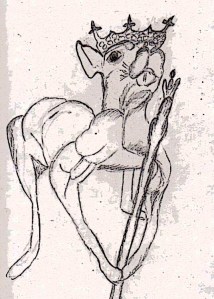
For example, in response to the Tarot Storytelling Spread I drew the Big Red Kangaroo as the King of Wands.
Kangaroo’s are herbivorous. They reside throughout Australia, Tasmania and New Guinea. Kangaroos have powerful, long hind legs and feet for leaping and jumping with. Their long tails thicken at the base to help them balance. Each of their hind feet has 4 toes, this number represents foundations.
This big Red Kangaroo, proudly wearing his crown of authority, has the power to create a safe and secure environment for his mob. The Red Kangaroo has an innate capacity to adapt to new situations and environments. Kangaroos are extremely focused beings, with their energy fields tightly woven around them with no room for distractions.
If hunted by a Dingo, human or a rare Tasmanian tiger, the Big Reds are very fast and hop effortlessly to safety without a moments thought about where they are going. They use their strong instincts to guide them.
For us humans, there is a great lesson to be learned from this – instead of thinking about every single, most minute step we take we must let our instincts guide us.
When Victoria went into its fifth lockdown last week, classes that I had offered in a couple of Library settings were cancelled. This is disappointing for everyone and adds to the cocktail of negative noise that we have all been dealing with.
As Nitchke explains “the human brain has the capacity to imagine all the worst things that could happen. And the more uncertainty there is — especially if that uncertainty is coupled with gloomy hypotheticals — the more likely the brain is to conjure up and fixate on the worst-case scenarios.
I wish it were otherwise but we are going to be faced with uncertainty for quite some time! So I decided that one way of providing a tiny bit of certainty is to offer regular writing/art sessions in a Zoom setting.
Participants will have a regular meeting time and projects (lockdown friendly if the need arises) to occupy themselves before meeting again.
The cost is $15 per a one and a half hour session.
If you are interested in joining a group of a maximum of 5 participants, for a block of 6 weeks, on a Tuesday evening at 8 pm AET simply email heatherblakey at fastmail dot fm. Other times can be made available depending on interest.
Writing for Wellness
Pens, crayons, pencils and IV tubes may not seem to have much in common but the arts are increasingly touted as a form of healing that can be as relevant to a patients wellbeing as medication. A developing body of research shows that expressive writing helps calm the mind and emotions, and increases feelings of happiness and wellbeing.
In this course we will use guided writing activities as a gentle approach to personal wellbeing. You will be offered tools which you can take away and use in your daily writing and art practice.
The enjoyable and easy-to-do activities will help you:
reunite with your most creative self
dip into Mnemosynes Well of Memory using simple lists as stepping stones
apply guided imageries and visual imagery as a kick starter to daily writing
alter your perspective by communicating with fragments of nature
experience the catharsis that comes with writing letters to past and future selves
create detailed portraitures
explore a range of emotions
About Heather Blakey
Heather Blakey has had over thirty years experience as a secondary school teacher in Melbourne’s Northern suburbs and she has recently graduated as a Master of Social Work at Monash University.
Between 2000 and 2010 she built and managed the critically acclaimed Soul Food Cafe a site which was acknowledged by Writers Digest and authors such as Sark and Jean Houston. While she no longer runs this labyrinthine website Soul Food informs how she works and has influenced writing courses that she runs regularly.
Heather describes herself as a purveyor of stimuli and an artistic midwife. She has worked as a specialist teacher of writing with people of all ages and believes that the expressive arts, and writing in particular, not only promotes wellness in those who trust the process and engage but helps people identify and value their unique voice.
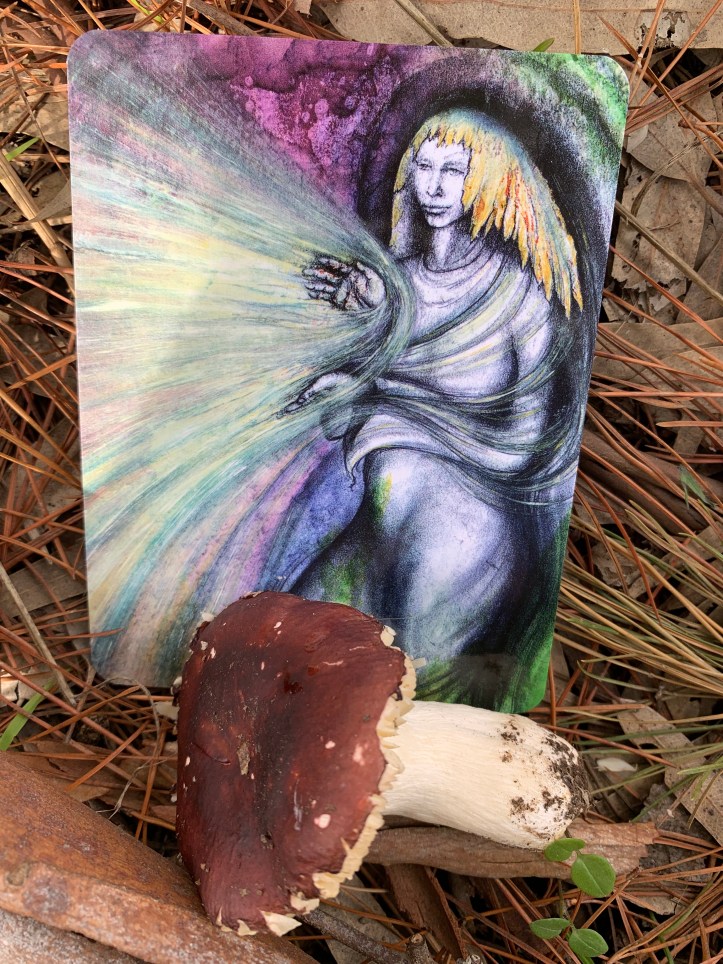
I pause to commune with the serene spirit of the Fungi. She may live in darkened places but her light shines brightly and she is full of wisdom.
“For millennia, western thinking has been dominated by the idea that we are separate from, and superior to, the rest of nature. Plants and fungi are seen as dumb, mechanical processes that we can plunder for materials and chemicals without considering how we relate to them. Other cultures see other lifeforms as peers. They are viewed as creatures deserving of respect and from whom we might be able to learn something.
From our human-centered perspective, fungi seem rather inert and unimpressive. They don’t move much and seem to be uninteresting passive objects rather than intelligent beings. Just because they don’t move, however, doesn’t mean they don’t have behavior”.
Life as we know it would not exist without fungi. They are the critical link in the biological cycle of life and death.
Fungi are the great recyclers. They play a major part, with prokaryotes such as bacteria, in breaking down organic matter. Without them we would soon be up to our ears in dead plant matter and animal carcasses. Worse still, we would be surrounded by mountains of dung that would not rot.
Plants would soon run out of fresh nutrients. Animals in turn would go hungry.
There would be no forests. Few people realize that trees rely on networks of fungi working in partnership with their roots. Without fungi to make nutrients available, trees would be unable to survive. Consider the many roles trees play in supporting life on earth and you’ll realize the importance of this union.
I pause to talk to the spirit of the Wattle. She is feeling joyful as she dresses in a golden ballgown that she will wear for her coming out again this season. She tells me that her yellow gown will swirl when she dances on the Spring winds. As she talks a pleasing memory of youthful days, wearing my yellow taffeta ballgown, dancing with my father at the local ball drifts by.
Once upon a time, long before there was once upon a time, an old crone decided that she needed to make one final creative journey and add another star to the constellation in the skies that shone within her private universe. She was not in the least surprised when a Raven and a Donkey insisted on coming along, for they had travelled with her before.
What did startle her was the arrival of a flamboyant, charismatic Sulphur Crested Cockatoo named Bonnie. She suspected that Bonnie was one of the flocks that had raided her beloved Ornamental Pistachio Tree each year because she was quite sure that she had seen and photographed a bird, with attitude, who looked just like her.
Duncan the Donkey made it clear that he was getting too old to carry heavy loads and while the Crone agreed that it would be good to travel lightly she did ask Duncan to carry some of her art supplies and made sure to tuck a few of her Tarot and Oracle cards into her bag. She had relied on them during the long ‘lockdowns’ and wasn’t about to go anywhere without her most trusted ones.
Bonnie’s sharp eye caught a glimpse of these boxed treasures and, because she is such an inquisitive bird, wanted to know more about them. The Crone began to explain the Major Arcana to her and was surprised to discover that Bonnie was more fascinated than any of her human friends had been.
“Perhaps you will teach me about these Majors as we travel” said Bonnie.
“What a good idea” said the Crone. “There is so much that I am yet to learn and we could always learn together”.
Benebell Wen’s review of the Lions Gateway Tarot by Jessica Henry is comprehensive. Some tarot readers bond with a deck by ‘interviewing’ it, but another way to get to know a deck is to use it for a month long challenge such as the Once Upon a Tarot Challenge. In this case I am using the Sakki Sakki Tarot to help develop a character but you can always take the journey to help gain self awareness or to gain focus and set goals.
It will come as no surprise to anyone who has followed me on Instagram that I do not profess to be a Tarot reader. I certainly do not claim to be familiar with the meanings of all the cards. My primary interest has been exploring the potential of these mini galleries of art to inspire the creative arts and support healing.
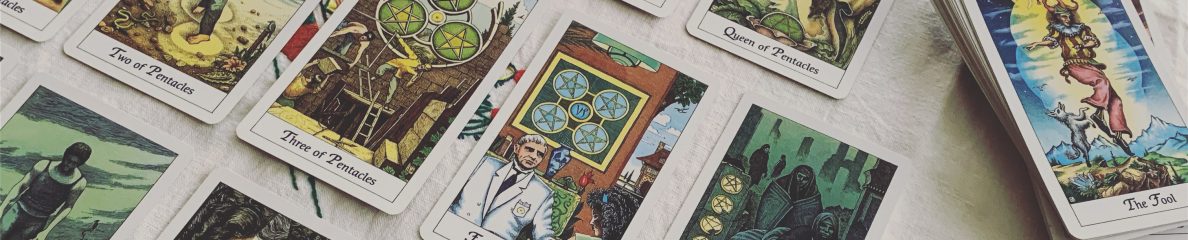
I began the process by listening to Julie Andrews sing Getting to Know You as I shuffled the Everyday Witch cards. It was the Six of Pentacles, a card all about giving and receiving that emerged. So clearly the Witch depicted in this card is prepared to help even the playing field and share some of her knowledge with me; teach me about the world of Tarot.
So when I was told by an experienced Tarot reader that she wished that the Everyday Witch had been available when she was learning 20 years ago, that she strongly recommends this deck to beginners I figured it was time to go beyond the interview process and actually get to know this deck, get to know Tarot better. Of course I have made resolutions like this before but I am not going to beat myself up because I am aware that PTSD issues and the nature of technology have impacted on my capacity to focus.
For now it is my intention to set up some Tiny Tea each day and work with some cards. I am hoping to study the Everyday Witch in detail and draw comparisons with cards in other decks that I have in my collection.







 The Tarot Midwife