Tarot Play Time – Play Theatre

I think I am not the only one intrigued by the picturesque of early Tarot cards. What do they really represent? Who drew them? Who put all these icons together?

Then I saw Dario Fo, the great Italian comedian of Comedia dell Arte, play writer and Nobel Prize winner, acting on stage playing the hilarious figure of a barbarous Pope (I cannot recall who). and I thought that something of the medieval feasts, mysteries and banquets were radiating from the stage… from Origins of the Tarot Cards from Medieval Mystery Plays

I spied with my little eye the Magnetic Play Theatre that I obviously kept, which belonged to my daughter when she was little.

It only took a moment to find out about the connection between Tarot and Medieval Playhouses and for my inner child to point out that this would be a fun way to play with Tarot and write all at the same time.

So I set up my Rose and Swan Playhouse and called upon the Fiddler on the Roof Matchmaker to make me a match. The Lions Gateway Tarot by Jessica Henry was the obvious choice and I have to say it was love at first sight. These two may have quite the romance as they bounce off one another.

As I laid down the card that emerged from Henry’s beautiful deck I thought of fairy stories and the Canterbury Tales.  Given Tarots power to teach about morality, I might even be happy to  write a scene for a morality play.

Aperture Stories

“Everyone has a story,” renowned anthropologist Barbara Myerhoff stated, and these stories “told to oneself and others can transform the world.” The name Story Aperture is inspired by Barbara Myerhoff, who described the way a personal story can provide an opening to understand not only one person’s life, but larger truths about the human experience.

Aperture stories are stories which come when we put the light on symbols to be found within Tarot, Oracle, Lenormand or Playing cards.  When we focus like on what the symbol is telling us, we are find deeper meanings which enable us to adapt and adjust our narrative. When we work with an aperture we see well beyond overt meanings and tap into important healing structures.

When we work intuitively with Lenormand, Tarot and Oracle cards we hold micro art galleries in our hand and we have access to insights that have been drawn from the collective unconsious.

When we use a camera it is the depth of field that will determine:

  1. where your viewer’s eye is drawn in a photograph, and
  2. whether or not the photograph is telling a story.

If we keep the camera lens in mind as we examine the cards that have emerged more light is shone on particular features. Often it is the understructure which reveals an entirely fresh model for telling a story. When we work intensively with an image it can help us  face a difficult situation or deal with and heal trauma.  

I have found it inspirational to sit with another person, over a Devonshire tea (Coffee), to sling cards, work intuitively and to listen to the stories that rise up. In the process of working out what the understructure is telling us, at a particular moment in time, we are telling aperture stories.

Telling Tarot Stories

Great Tarot readers, like writers, know how to weave the story between the Tarot cards to create highly engaging and meaningful Tarot readings for their clients. They see patterns between the cards and combine these intuitive messages into a beautiful story that is unique to the client and their situation. This exercise is good for writers looking to warm their hand by practicing on a daily basis. It is also a good practice for a tarot reader to strengthen their spontaneous story telling skills

Every Tarot card contains its own unique story and each story can be expanded by using more than one card. Every card in a Tarot deck is connected by an invisible thread.

As writers looking to maintain a daily practice Tarot cards are a wonderful source of inspiration.

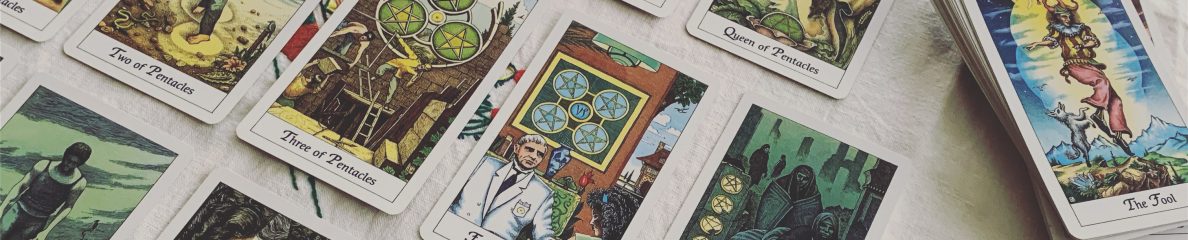
Over a cup of tea or coffee one way to start the day is to quietly shuffle a pictorial deck and draw some cards. In this instance I chose the Tarot of the Durer which is an art deck compiled by taking scenes from some of Durer’s famous work. I opted to choose just two cards.

Lay out your cards as I have done here.

  • Carefully look at the pictures. Make sure to take in as much detail as possible. It is important to look very closely. For example, did you notice that the eagle is chained and that there is an ominous raven shaped cloud above the old man in the 10 of Pentacles? What is your impression of Temperance’s mood? How is she relating to the cow? What is her connection to the elderly man in the 10 of Pentacles?
  • What are the different elements? Plants? Buildings? Flowers? Animals? What is the landscape? Are there people in the card? What is the person in the picture doing? What objects do you see? Why do you think they are there? What’s in the background? What’s in the foreground? How do all of these different elements come together into a coherent story?
  • Notice every small and large detail and make a note of it. Absorb the entire card into your mind.
  • Now set your timer for 20 minutes. And start writing and sketching, remembering that you are not in a writing or art competition.
  • Make up a story as you go along. Use the elements from the picture in your story. You can be as creative as you like – just let yourself go wild. Write down a story in the 20 minutes you’ve set aside.

Warming the Hand – Honing One’s Knowledge of Pentacles

I keep to this routine every day without variation. The repetition itself becomes the important thing; it’s a form of mesmerism. I mesmerize myself to reach a deeper state of mind.
Haruki Murakami

Write freely and as rapidly as possible and throw the whole thing on paper. Never correct or rewrite until the whole thing is down. Rewrite in process is usually found to be an excuse for not going on. It also interferes with flow and rhythm which can only come from a kind of unconscious association with the material.
Steinbeck

When I run writing classes I always promote the benefit of writing on a daily basis to keep the ‘hand warm’ so to speak.

In this instance I have chosen a character, the Hermit, from the Major Arcana and placed him alongside the court cards of the suit of Pentacles. Then I laid out the 10 cards to represent his journey back into the outside world.

To begin I have decided that the Hermit has been living in isolation in Cappadocia for many years. Word has reached him about the dramatic changes that have taken in the outside world and he has decided to venture out again.

I will make notes about his journey as he moves through this suit.

Of course, working in this way is also a good way to sharpen your knowledge of the cards in a new deck and refine your readings.

Everything Has A Story

Like Sleeping Beauty I am waking up – woken by the voices of all the things I have never thought to stop and listen to, that are eager for me to tell their story. As I listen I have some Tarot Cards with me because they help ‘translate’ the message from an item like a traffic sign or the windmill that has stood out in the weather for decades
The Tarot Midwife November 9 2020

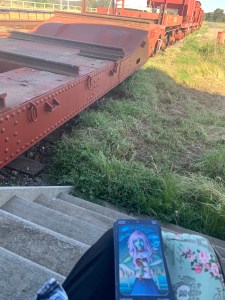
My loyal companion, Archie, a Finnish Lappie, and I headed out to the Muckleford Railway Station armed with a copy of the Little Red Engine. We had been there the day before and decided that we would go back and read this story to the carriages that are lined up on the side tracks.

We found a place to sit and began reading this delightful old children’s book, that once belonged to my children, to the old railway carriages. We didn’t get right through the story because we were both suddenly aware that these so called inanimate carriages and Aunty Jack, the old engine that pulled them on long hauls, were getting quite emotional.

To check what had upset everyone I pulled a card from the Tarot of the Sweet Twilight and out popped the Three of Swords.

It all became very obvious. These loyal, hardworking, heavy duty carriages were devastated to have found themselves abandoned on side tracks here, while Betsy, a light weight steam train blew its whistle and gloated as it skipped past, filled with passengers, city slickers, enjoying a journey down memory lane.

When things calmed they said that they did appreciate hearing the story and that if I would come back they would tell me of some of the places they passed when they were carrying goods and animals back in the day when the railway was the main means of transport.

Aunty Jack the old engine who pulled huge loads through Central Victoria.

Aunty Jack, the Empress, the powerful engine who pulled these carriages for years, brightened at the prospect of having someone listen. I told her about my Great Grandfather who worked as an engineer and oversaw the laying of rails in the 1860’s and she was delighted to hear about his foresight and passion for rails. She suggested that when I come back I tell her more about his days building the railway that bought such change to colony.

Footnote: A delightful mechanic/engineer, who I sat enjoying a cup of coffee with at Dig in nearby Newstead, told me that railway men always give engines female names. He said that in his younger days the really strong ones, with a ton of personality, were invariably known as Aunty Jack. It was he who shared that some were known as Betsy and Val. I decided that the old Steam Train that travels between Castlemaine and Maldon, through the Muckleford Station, is known here as Betsy.

Tarot Based Memoir

Choose a pictorial deck and lay out a complete minor arcana. You might, for example lay out a suit that is alignment with your zodiac sign. For example, I am a Virgo and I might choose to use the earth based pentacles.

Use the cards to tell write a narrative about your life. Think of the first 3 cards being the beginning of the story, the second set of three cards being the middle of the story and the last three cards being the end.