I keep to this routine every day without variation. The repetition itself becomes the important thing; it’s a form of mesmerism. I mesmerize myself to reach a deeper state of mind.
Haruki Murakami
Write freely and as rapidly as possible and throw the whole thing on paper. Never correct or rewrite until the whole thing is down. Rewrite in process is usually found to be an excuse for not going on. It also interferes with flow and rhythm which can only come from a kind of unconscious association with the material.
Steinbeck
When I run writing classes I always promote the benefit of writing on a daily basis to keep the ‘hand warm’ so to speak.
In this instance I have chosen a character, the Hermit, from the Major Arcana and placed him alongside the court cards of the suit of Pentacles. Then I laid out the 10 cards to represent his journey back into the outside world.
To begin I have decided that the Hermit has been living in isolation in Cappadocia for many years. Word has reached him about the dramatic changes that have taken in the outside world and he has decided to venture out again.
I will make notes about his journey as he moves through this suit.
Of course, working in this way is also a good way to sharpen your knowledge of the cards in a new deck and refine your readings.
Writing has tremendous energy. If you find a reason for it, any reason, it seems that rather than negate the act of writing, it makes you burn deeper and glow clearer on the page. Ask yourself, “Why do I write?” or “Why do I want to write?” but don’t think about it. Take pen and paper and answer it with clear, assertive statements. Every statement doesn’t have to be one hundred percent true and each line can contradict the others. Even lie if you need to, to get going. If you don’t know why you write, answer it as though you do know why.
— Natalie Goldberg, Writing Down the Bones
When I am running writing classes I like to offer speed stream of consciousness writing activities to ‘warm the hand’.
This spread by @radiantunknown is the perfect spread to generate some writing, preferably on scrap paper. I encourage people to begin by sketching, posing some questions and making lists of things that come to mind.
I suggest that you place your primary character on a page and then make use of the following format to create your own character.
No cheating. Do not simply fill in the blanks by describing yourself or someone you know. Instead, fill in the blanks describing someone you’d find it interesting to know. Then, remembering that conflict is the essence of all dramatic writing, repeat the process by imagining a character whose value, attitudes, etc. would likely put them in opposition to the first character you invented.
Full Name:
Nicknames:
Sex:
Age:
Height:
Weight:
Hair:
Eyes:
Skin:
Posture:
Appearance:
Health:
Birthmark:
Abnormalities:
Heritage:
Where born:
Where live:
Favorite food:
Favorite subject in school:
Favorite game as child:
Best memory:
Worst memory:
Smoke/Drink/Drugs Profile:
Favorite section of newspaper:
Favorite type of music:
Last book read:
Last movie seen:
Morning or night person:
Introvert/Extrovert:
Indoor or outdoor person:
Greatest fear:
Closest friend:
Dearest possession:
Favorite season:
Class:
Occupation:
Education:
Family:
Home Life:
IQ:
Religion:
Community:
Political Affiliation:
Amusements/Hobbies:
Reading Interests:
Sex Life:
Morality:
Ambition:
Frustration:
Temperament:
Attitude:
Psychological Complexes:
Superstitions:
Imagination
Then we set a timer and write for twenty minutes without thinking or worrying about grammar.
As a follow on you can put your character in the centre of this spread and begin building on their story using the cards that emerge.
Like Sleeping Beauty I am waking up – woken by the voices of all the things I have never thought to stop and listen to, that are eager for me to tell their story. As I listen I have some Tarot Cards with me because they help ‘translate’ the message from an item like a traffic sign or the windmill that has stood out in the weather for decades
The Tarot Midwife November 9 2020
My loyal companion, Archie, a Finnish Lappie, and I headed out to the Muckleford Railway Station armed with a copy of the Little Red Engine. We had been there the day before and decided that we would go back and read this story to the carriages that are lined up on the side tracks.
We found a place to sit and began reading this delightful old children’s book, that once belonged to my children, to the old railway carriages. We didn’t get right through the story because we were both suddenly aware that these so called inanimate carriages and Aunty Jack, the old engine that pulled them on long hauls, were getting quite emotional.
To check what had upset everyone I pulled a card from the Tarot of the Sweet Twilight and out popped the Three of Swords.
It all became very obvious. These loyal, hardworking, heavy duty carriages were devastated to have found themselves abandoned on side tracks here, while Betsy, a light weight steam train blew its whistle and gloated as it skipped past, filled with passengers, city slickers, enjoying a journey down memory lane.
When things calmed they said that they did appreciate hearing the story and that if I would come back they would tell me of some of the places they passed when they were carrying goods and animals back in the day when the railway was the main means of transport.
Aunty Jack the old engine who pulled huge loads through Central Victoria.
Aunty Jack, the Empress, the powerful engine who pulled these carriages for years, brightened at the prospect of having someone listen. I told her about my Great Grandfather who worked as an engineer and oversaw the laying of rails in the 1860’s and she was delighted to hear about his foresight and passion for rails. She suggested that when I come back I tell her more about his days building the railway that bought such change to colony.
Footnote: A delightful mechanic/engineer, who I sat enjoying a cup of coffee with at Dig in nearby Newstead, told me that railway men always give engines female names. He said that in his younger days the really strong ones, with a ton of personality, were invariably known as Aunty Jack. It was he who shared that some were known as Betsy and Val. I decided that the old Steam Train that travels between Castlemaine and Maldon, through the Muckleford Station, is known here as Betsy.
Joan of Arc, a peasant girl living in medieval France, believed that God had chosen her to lead France to victory in its long-running war with England. With no military training, Joan convinced the embattled crown prince Charles of Valois to allow her to lead a French army to the besieged city of Orléans, where it achieved a momentous victory over the English and their French allies, the Burgundians. After seeing the prince crowned King Charles VII, Joan was captured by Anglo-Burgundian forces, tried for witchcraft and heresy and burned at the stake in 1431, at the age of 19. By the time she was officially canonized in 1920, the Maid of Orléans (as she was known) had long been considered one of history’s greatest saints, and an enduring symbol of French unity and nationalism. Source: History
It has been almost 600 years since the trial and execution of Joan of Arc, and her memory hasn’t faded. From Martyr, saint and military leader Joan of Arc, acting under divine guidance, led the French army to victory over the English during the Hundred Years’ War.
Joan of Arc played an important role in medieval society. She helped to structure women’s right, such as fighting in war and asking to lead an army. During the medieval society, women had no rights to fight with an army, nor did they lead an army to fight for their country.
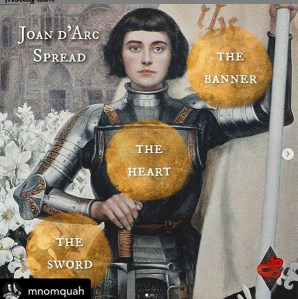
Much has been written about Joan d’Arc. This spread encourages us to examine the qualities that we identify ourselves as having. I have used the Tarot of the Sweet Twilight. I began by laying out my birth cards and then shuffled and drew three cards. Given how much that is revealed in these cards, I plan to journal in more detail.
Those who work with me know that I am a purveyor of creative stimuli, an artistic midwife who has worked as a specialist teacher of writing for decades. While I have worked in this field all my life, I have known fallow times so I do like to regularly take my creative pulse. Working with a Tarot Spread is a good way of taking one’s creative pulse.
There are a vast array of spreads available online and in books that specialise in presenting a diverse range of tarot spreads, suited to all occaisons. I like this particular spread because it helps me keep on track and monitor progress, particularly as, in November 2019, I committed to spending years working closely with symbols and to learning more about how they can ignite the creative flame and draw out words that are so often trapped behind internal walls of steel.
1. What does my creativity want to say? 2. What are my creative strengths? 3. What are my creative challenges? 4. How does my creativity speak to me? 5. How can I best focus on my creativity moving forward?
As a New Year in my creative life dawns I decided to use a spread presented by @thepathtarot. I decided to use the Sakki Sakki Tarot because Monika Clio Sakki has specifically focused on providing Tarot and a Companion Book which actively supports creative journeys.
Rather than lay the cards out as suggested I chose to lay them out on a hand, with the first card beginning at the thumb and the five cards moving back towards the little finger. I also asked my Runes to strengthen the reading by offering three messages for me.
Not surprisingly this reading proved quite challenging, especially with the appearance of two cards which are universally regarded as ‘darker’ cards. Ultimately it was the Runes which completed the picture for me.
My creativity wants me to know that I am gestating, that I am pregnant wth possibility. She reminds me that true creations come at the right time.
The Six of Cups tells me that the way I played as a child has nurtured my creativity and has been a constant source of strength. I stop and remember Archie Hair, an old friend from my childhood, his Box of Natural Wonders, his treasure hunts and his playfulness. I know that he passed these gifts on to me and that they are a key to my creativity.
Experience has shown me that in times of sadness, grief and disappointment my creativity wanes and I have been silenced for significant periods of time. Given the recent death of my beautiful Neeky, a beloved companion for the past ten years, I am mindful that I need to be careful not to be silenced by the grief I am feeling. I am so aware of the huge void she has left.
The Seven of Swords is not usually well received but in this instance the seven of swords represents the power of thoughts. The swords represent aspects of my thought processes. My creativity keeps insisting that I think as strategically, as possible, that I find the gold in the troubled times, that I gather ideas, research and keep moving forward.
I keep moving forward, try not to dwell in the past, because I know that the very swords that have pierced my heart have ultimately fuelled my creativity. I honour my scars and heart wounds.
Three messages from the Runes
Raido: I am no longer burdened by what I have left pinned to the ground and left behind
Jera: The ground is fertile and ready to be planted
Through techniques of pathworking (guided meditation), your imagination can shine a magic mirror on your personality. This inner landscape reveals your world as your unconscious sees it – a perspective that enables you to make dramatic changes.
The Queen of Cups: The Gill Tarot by Josephine Gill
Make an appointment to write! Join me, read Tarot over Tiny Tea and spend time working on your journal.
Joseph Gill’s The Gill Tarot, first published in 1991, is a beautiful deck to work intimately with and provides amazing imagery for those wanting to journal or path-work.
A pathworking takes you on a journey through an inner landscape. Path-working as a technique is derived from magical uses of the Kabbalistic Tree of Life. In that system, a path-working is a journey along one of the 22 paths of the Tree of Life, each of which has a specific set of landscape and symbolism associated with it (and corresponds to one of the twenty-two cards of the Major Arcana of the Tarot).
Alternatively you can engage in a visualisation by focusing on the specific images in front of you; sometimes the image tells a story or involves travelling through a landscape (real or imaginary); sometimes it is intended to bring about a specific result.
At other times you may dialogue with a aspect of your personality as represented by someone like Gill’s Queen of Cups.
Anastasia Riversleigh is just one of my alter egos. She is a member of the Skull Clan who is currently working, primarily, with the Tarot of the Vampyres. Given that she is taking this opportunity to do important shadow work she will be leaning on numerous decks and other resources.
Visit her and you will find a detailed journal which records her newest adventure, in residence, living and playing with many interesting internal characters at Shadwell Manor and on the old Ghostly Spanish Galleon that sails the seven seas.
There can be no doubt that everyone on the planet is faced with a tower moment of monumental proportions. Some of us understand that, much as we may desire it, there is no going back.The reality is that we can only adapt and adjust. Caroline Myss is one of the people who understands that we need to be built to cope with change.
Watch her emotional talk and then draw some cards to guide daily steps and provide some fresh direction. Feel free to share any inspiration in the comment section below.
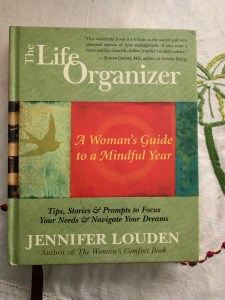
We all yearn to have time for personal needs and creative dreams — after all, this is our life to make the most of. And we all know how hard it is to remember what really matters. With distractions from jobs, aging parents, and children — not to mention women’s perennial fear of being labeled “selfish” — following our own desires and dreams can become ever more elusive. The Life Organizer aims to help you shift your focus, augmenting traditional goal setting with the ease that comes from steady inner listening and mindfulness. It will become your trusted companion — and maybe the most important book you’ll ever own.
I agree with Davy and Tracy that “Tarot is a fantastic tool to use for personal development and daily mindfulness practice. The imagery on most tarot decks are wonderful prompts for journaling and meditation.
Tarot helps to focus your mind, and engages your intuition and sub-conscious, aiding in your ability to facilitate connections and explore different ways of thinking about any aspect of your life or circumstances”.
Three weeks ago I pulled out this book by Jennifer Louden, that had been resting on my shelves for many years, and decided that, while there are many spreads and challenges that help us to adapt our thinking, I would apply Louden’s 52 weeks of Mindful Living and draw cards in response to the questions she puts forward each week.
For example the first week posed the following:
What experience or feeling do you yearn for today?
How might my shadow or time monsters block me from trusting myself or exploring the yearning I have named?
What would help my body feel listened to and loved?
How have I been talking to myself lately?
Initially I worked with the Mary El Tarot and these are just three of the cards I meditated upon in response to the questions posed for the first week. Then I worked with the material that emerged in my journal.
Personally I am not in to reinventing the wheel so do check out Davy and Tracy’s page about how they use Tarot for personal development and mindfulness. What I have found is that this can also be done in a group situation or with a partner. The dialogue that emerges is invariably very stimulating.
“I don’t believe in things like that – fairies or brownies or magic or anything. It’s old-fashioned.’ ‘Well, we must be jolly old-fashioned then,’ said Bessie. ‘Because we not only believe in the Faraway Tree and love our funny friends there, but we go to see them too – and we visit the lands at the top of the Tree as well!” ― Enid Blyton, The Folk of the Faraway Tree
Whenever the world is getting all a bit too much I seek out alternate realities. There is a Fey Guide waiting in this tree, ready to take me on another adventure. I have packed a suitcase, I have my tarot deck and I am ready to go.
I cannot say that I was a devotee of Alice in Wonderland. Instead it was Enid Blyton’s Magic Faraway Tree series that captured my imagination as a child growing up in the 1950’s.
The Faraway Tree is best described as a slow, gentle series of adventures that take place in a magical tree and the lands it connects to in the clouds. Originally published in 1939, the language is lyrical and playful — a slide is called a slippery slip — and young readers will probably dream about how the kids are left to play in the woods for an entire day by themselves.
I loved, still love these stories for their loveable characters, magical lands, silliness ( the Saucepan Man’s songs and forgetfulness had me giggling every time) and the exciting cliffhangers that kept me enthusiastically reading chapter after chapter. Not so long ago, during our blistering hot summer, I listened to audio book adaptions and fell in love with the series all over again. Silky and Moonface have not lost any of their appeal and I still adore the angry pixie.
Of course, some point to the pretty standard gender roles but it was 1939 and the fact that the roles are decidedly out of place in 2020 will not diminish the joy I feel when I read the books.
The truth is that the Magic Faraway Tree, combined with the influence of Archie Hair, an elderly prospector whose home in the bush was a place I loved visiting as a child, filled me with wonder and have each contributed to me having a rich inner life, an inner life that has sustained me through some very difficult periods. Perhaps not surprisingly, thanks to such influences, when I ran the Soul Food Cafe between 2000 and 2010 I took countless travellers through a portal into the fantasy world of Lemuria and preserved the journeys in annual advent calendar features.
Fast forward to 2020 and I now find myself in world put into hibernation by a new pandemic. It has been over seven weeks since we went into lockdown in Australia and there have been many reports indicating that social isolation and being ‘confined to barracks’ is having a detrimental impact on people’s mental wellbeing.
Thank goodness for my passion for Tarot. In this situation I have found it self soothing to pack my bag, slip through a portal and Travel Within A Tarot Deck.
Not surprisingly I chose the Path Through the Enchanted Forest, a magical deck which conjures some of the charm of the Faraway Tree. When I work with this deck I not only drift back in time but find that my imagination is fired. After shuffling my deck I found myself standing in a forest, alongside a gingerbread house and I was, quite frankly stunned by how the cards continued to fall.
Invariably others, inspired by this idea, have gone in different directions but the feedback I am getting suggests that, at a time when flights are cancelled and borders are closed, this is one kind of travel that can fire up our creative juices.
Will you join in? I am thinking of setting up a flight centre, a ‘Travel Agency’ where those who read about the travels of others will be inspired you to join in the fun. Considering there are no charges and all you have to do is pull out a much loved Tarot Deck, even Ryan or Tiger Air will not be able to beat this offer. And just think of the travel brochures we could conjure up! So much potential!
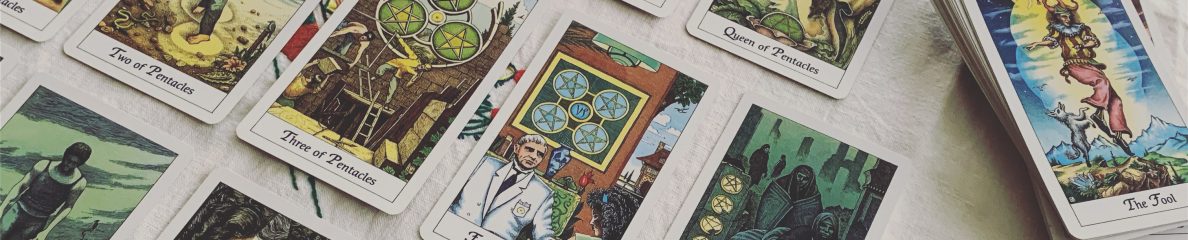


 I suggest that you place your primary character on a page and then make use of the following format to create your own character.


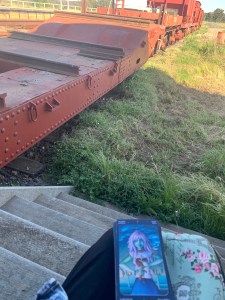 To check what had upset everyone I pulled a card from the Tarot of the Sweet Twilight and out popped the Three of Swords.


 I agree with


 The Tarot Midwife